

KLI Colloquia are invited research talks of about an hour followed by 30 min discussion. The talks are held in English, open to the public, and offered in hybrid format.
Join via Zoom:
https://us02web.zoom.us/j/5881861923?omn=85945744831
Meeting ID: 588 186 1923
Fall-Winter 2026/27 KLI Colloquium Series
1 October 2026 (Thurs) 3-4:30 PM CET 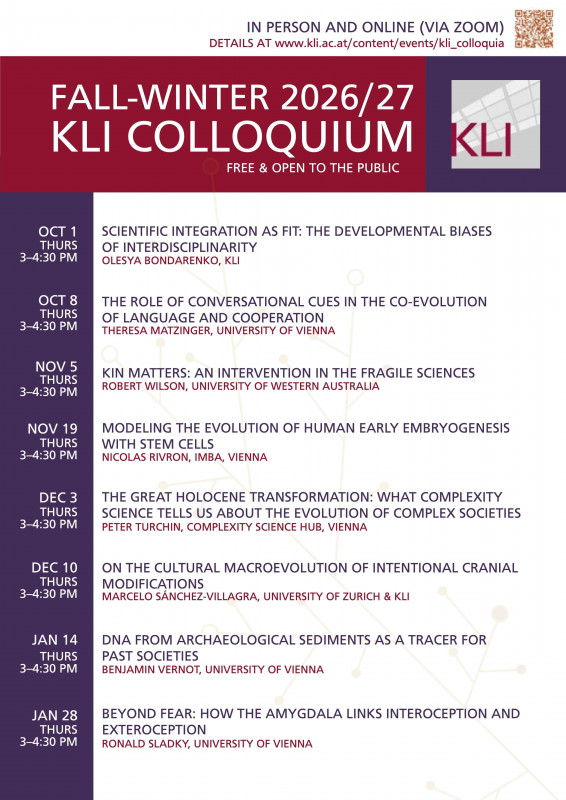
Scientific Integration as Fit: The Developmental Biases of Interdisciplinarity
Olesya BONDARENKO (KLI)
8 October 2026 (Thurs) 3-4:30 PM CET
The Role of Conversational Cues in the Co-Evolution of Language and Cooperation
Theresa MATZINGER (University of Vienna)
5 November 2026 (Thurs) 3-4:30 PM CET
Kin Matters: An Intervention in the Fragile Sciences
Robert A. WILSON (University of Western Australia)
19 November 2026 (Thurs) 3-4:30 PM CET
Modeling the Evolution of Human Early Embryogenesis with Stem Cells
Nicolas RIVRON (Institute of Molecular Biotechnology/IMBA, Vienna)
3 December 2026 (Thurs) 3-4:30 PM CET
Peter TURCHIN (Complexity Science Hub, Vienna)
10 December 2026 (Thurs) 3-4:30 PM CET
On the Cultural Macroevolution of Intentional Cranial Modifications
Marcelo SÁNCHEZ-VILLAGRA (University of Zurich)
14 January 2027 (Thurs) 3-4:30 PM CET
DNA from Archaeological Sediments as a Tracer for Past Societies
Benjamin VERNOT (University of Vienna)
28 January 2027 (Thurs) 3-4:30 PM CET
Beyond Fear: How the Amygdala Links Interoception and Exteroception
Ronald SLADKY (University of Vienna)
KLI Colloquia 2014 – 2026
Event Details

Picture Gallery
The emergence of the new biological subdisciplines of biocomplexity and bioinformatics at the end of the twentieth century marks the continuing attempt to provide a new potentially unifying framework for biology based on concepts of information. Informational thinking first entered biology through neurobiology in the 1920s; it entered genetics, developmental biology and evolution in the 1950s. It was central to the formation of molecular biology as a discipline with an epistemological framework identifiably different from predecessors such as biochemistry. “Information“ lies at the basis of the views of morphogenesis based on the idea of a genetic or developmental program. In recent years even ecological complexity has been characterized informationally. With the completion of several genome sequences “information“ has come to have a dual aspect: following the long-standing practice of molecular biology, DNA sequences have been interpreted as carriers of biological information; and new techniques have had to be developed to attempt to make sense of the astronomical quantities of information (qua sequences as strings of symbols) that have emerged from sequencing projects. In spite of such ubiquitous use of informational thinking in biology, the concepts of information that have been invoked have remained murky, and their use controversial. In recent years some theoretical biologists and philosophers have challenged the informational framework as being no more than a metaphor that masquerades as a theoretical entity; others have argued even more strongly for the centrality of information in biology. This workshop is designed to explore these issues, as they are formulated today, as well as how they have been articulated in different contexts during the last century. This workshop will bring together biologists with philosophers of science who have specialized in the conceptual and mathematical foundations of biology.
