

KLI Colloquia are invited research talks of about an hour followed by 30 min discussion. The talks are held in English, open to the public, and offered in hybrid format.
Join via Zoom:
https://us02web.zoom.us/j/5881861923?omn=85945744831
Meeting ID: 588 186 1923
Fall-Winter 2026/27 KLI Colloquium Series
1 October 2026 (Thurs) 3-4:30 PM CET 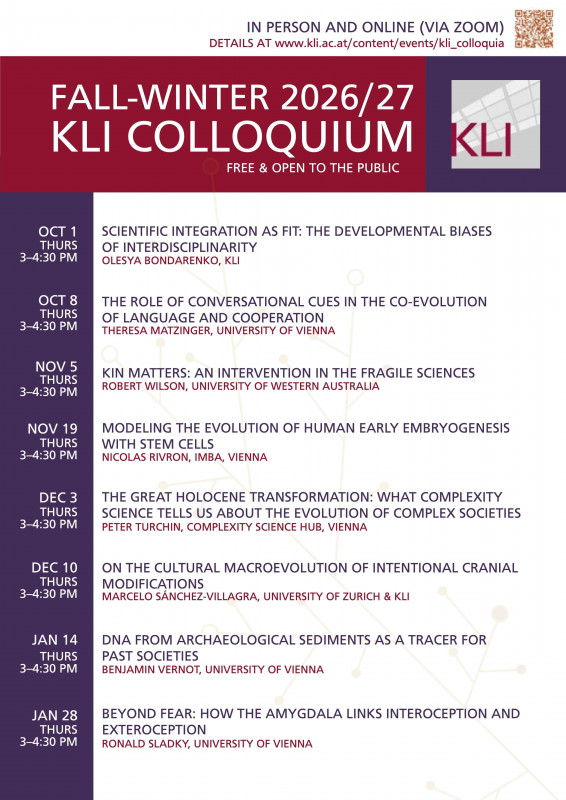
Scientific Integration as Fit: The Developmental Biases of Interdisciplinarity
Olesya BONDARENKO (KLI)
8 October 2026 (Thurs) 3-4:30 PM CET
The Role of Conversational Cues in the Co-Evolution of Language and Cooperation
Theresa MATZINGER (University of Vienna)
5 November 2026 (Thurs) 3-4:30 PM CET
Kin Matters: An Intervention in the Fragile Sciences
Robert A. WILSON (University of Western Australia)
19 November 2026 (Thurs) 3-4:30 PM CET
Modeling the Evolution of Human Early Embryogenesis with Stem Cells
Nicolas RIVRON (Institute of Molecular Biotechnology/IMBA, Vienna)
3 December 2026 (Thurs) 3-4:30 PM CET
Peter TURCHIN (Complexity Science Hub, Vienna)
10 December 2026 (Thurs) 3-4:30 PM CET
On the Cultural Macroevolution of Intentional Cranial Modifications
Marcelo SÁNCHEZ-VILLAGRA (University of Zurich)
14 January 2027 (Thurs) 3-4:30 PM CET
DNA from Archaeological Sediments as a Tracer for Past Societies
Benjamin VERNOT (University of Vienna)
28 January 2027 (Thurs) 3-4:30 PM CET
Beyond Fear: How the Amygdala Links Interoception and Exteroception
Ronald SLADKY (University of Vienna)
KLI Colloquia 2014 – 2026
Event Details

Picture Gallery
The study of communication systems and their evolution has benefited from efforts within a wide variety of disciplines. On the one hand, recent theoretical progress in animal communication and related empirical research have yielded rich perspectives on the forces that guide the emergence of communicative displays in species ranging from invertebrates, to birds, to primates. Research has also demonstrated that birds, dolphins, and apes are capable of learning to utilize important features of human communication in circumstances where systematic training is applied. In addition, the study of human communicative development has produced new perspectives on the flexibility of the human mind and new suggestions about the constraints on possible patterns of evolution for complex and flexible communicative systems. For example, work in artificial intelligence and connectionism is providing increasingly significant simulations of human communicative abilities, simulations that offer important tests of the plausibility of proposed theories of language function, and that also provide empirical proof regarding the power of relatively simple theoretical constructions to characterize some of the rich capabilities of human language users. Further, research on human infant vocal development has recently offered perspectives on ways that communicative systems can possess properties greatly surpassing those found in non-human systems while at the same time being severely restricted when compared to mature human languages. The workshop’s topic is the evolution of communicative systems of a broad range. The comparison among these, and the development of frameworks in which such comparison can be fruitfully made, is of paramount importance in the study of the evolution of communication.
