

KLI Colloquia are invited research talks of about an hour followed by 30 min discussion. The talks are held in English, open to the public, and offered in hybrid format.
Join via Zoom:
https://us02web.zoom.us/j/5881861923?omn=85945744831
Meeting ID: 588 186 1923
Fall-Winter 2026/27 KLI Colloquium Series
1 October 2026 (Thurs) 3-4:30 PM CET 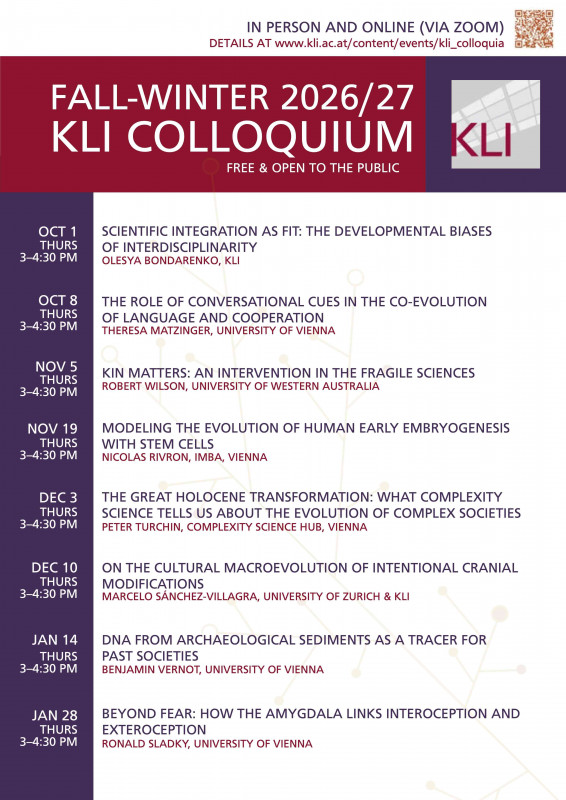
Scientific Integration as Fit: The Developmental Biases of Interdisciplinarity
Olesya BONDARENKO (KLI)
8 October 2026 (Thurs) 3-4:30 PM CET
The Role of Conversational Cues in the Co-Evolution of Language and Cooperation
Theresa MATZINGER (University of Vienna)
5 November 2026 (Thurs) 3-4:30 PM CET
Kin Matters: An Intervention in the Fragile Sciences
Robert A. WILSON (University of Western Australia)
19 November 2026 (Thurs) 3-4:30 PM CET
Modeling the Evolution of Human Early Embryogenesis with Stem Cells
Nicolas RIVRON (Institute of Molecular Biotechnology/IMBA, Vienna)
3 December 2026 (Thurs) 3-4:30 PM CET
Peter TURCHIN (Complexity Science Hub, Vienna)
10 December 2026 (Thurs) 3-4:30 PM CET
On the Cultural Macroevolution of Intentional Cranial Modifications
Marcelo SÁNCHEZ-VILLAGRA (University of Zurich)
14 January 2027 (Thurs) 3-4:30 PM CET
DNA from Archaeological Sediments as a Tracer for Past Societies
Benjamin VERNOT (University of Vienna)
28 January 2027 (Thurs) 3-4:30 PM CET
Beyond Fear: How the Amygdala Links Interoception and Exteroception
Ronald SLADKY (University of Vienna)
KLI Colloquia 2014 – 2026
Event Details

Picture Gallery
Evolutionary Developmental Biology (EDB) represents a new research agenda that unites evolutionary and developmental approaches to organismal form. In order to succeed, however, this resynthesis of development and evolution must include the environmental effects and physiological (endocrine / homeodynamic) processes that are part of organismal development. Ecology has been slow to embrace this new synthesis. Comparative physiology has been even slower, but there have been calls from funding agencies and leading researchers for an evolutionary comparative physiology. Similarly, with few exceptions, developmental biologists have been slow to embrace environmental and ecological-populational thinking in their approaches, either to development or to EDB. Very little attention has been given to physiological and metabolic processes that could mediate interactions between environ-ment, development, and evolution during ontogenetic and phylogenetic change. It is our contention that it may be environmental and physiological theories, emphasizing dynamic systems and equilibrium properties, that will contribute the next, significant chapter to formulating a true synthesis of evolution, indeed to completing the modern synthesis. The workshop intends to redress the omissions described above by bringing together a group of leading researchers from quite disparate fields of biology, and working on quite different systems, to examine the interface between environment, development, and evolution, in order to formulate what Scott Gilbert in a recent paper calls "eco-devo," but could be called "eco-evo-devo.” The workshop shall show the dynamic interaction between development and other physiological sciences, as well as how environmental signals are translated into change in biological systems. Because the topic requires a hierarchical integration of biological organization, the workshop includes approaches ranging from the molecular/genetic to the population level, and shows how embryonic development relates to life-history evolution, adapt-ation, and responses to environmental factors.
