

KLI Colloquia are invited research talks of about an hour followed by 30 min discussion. The talks are held in English, open to the public, and offered in hybrid format.
Join via Zoom:
https://us02web.zoom.us/j/5881861923?omn=85945744831
Meeting ID: 588 186 1923
Fall-Winter 2026/27 KLI Colloquium Series
1 October 2026 (Thurs) 3-4:30 PM CET 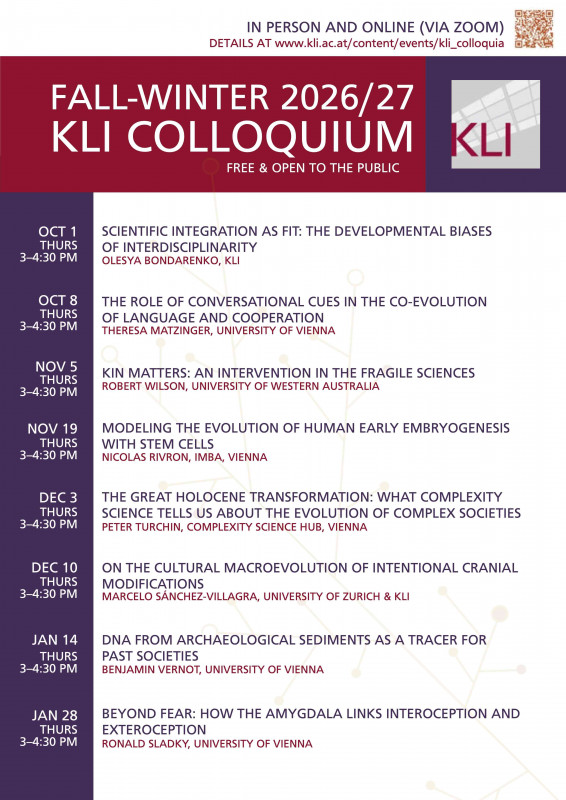
Scientific Integration as Fit: The Developmental Biases of Interdisciplinarity
Olesya BONDARENKO (KLI)
8 October 2026 (Thurs) 3-4:30 PM CET
The Role of Conversational Cues in the Co-Evolution of Language and Cooperation
Theresa MATZINGER (University of Vienna)
5 November 2026 (Thurs) 3-4:30 PM CET
Kin Matters: An Intervention in the Fragile Sciences
Robert A. WILSON (University of Western Australia)
19 November 2026 (Thurs) 3-4:30 PM CET
Modeling the Evolution of Human Early Embryogenesis with Stem Cells
Nicolas RIVRON (Institute of Molecular Biotechnology/IMBA, Vienna)
3 December 2026 (Thurs) 3-4:30 PM CET
Peter TURCHIN (Complexity Science Hub, Vienna)
10 December 2026 (Thurs) 3-4:30 PM CET
On the Cultural Macroevolution of Intentional Cranial Modifications
Marcelo SÁNCHEZ-VILLAGRA (University of Zurich)
14 January 2027 (Thurs) 3-4:30 PM CET
DNA from Archaeological Sediments as a Tracer for Past Societies
Benjamin VERNOT (University of Vienna)
28 January 2027 (Thurs) 3-4:30 PM CET
Beyond Fear: How the Amygdala Links Interoception and Exteroception
Ronald SLADKY (University of Vienna)
KLI Colloquia 2014 – 2026
Event Details

Topic description:
Reports of insights or "aha!” moments as source of innovative ideas at the core of creative processes fascinate people since Archimedes’ "Eureka!" discovery. Anecdotes about "insights" leading to key findings by renowned scientists like Helmholtz and Poincaré have built the starting points for researchers of productive thinking and gestalt psychologists’ takes on creative problem solving in the first half of the 20th century. They have paved the way for various approaches in creativity research to studying insights after WW2 up until the 1990s. Unresolved debates about the status of insights between "normal thinking" and "special processes" as well as growing criticism regarding the ill / too broadly defined concept has led to fading scholarly interest especially in (cognitive-)psychology after that. Recent contributions to the neuroscience of creativity show a regained interest in insight phenomena. Very often the approaches and study designs remain at the level of simply transferring cognitive psychology lab tasks (i.e., RAT) to fMRI studies though, without resolving any of the underlying conceptual issues. In order to be able to make contributions to clarifying them, it seems favorable to deploy an "in vivo" approach parallel to "in-vitro" studies and collect more "real world" data of creative processes to elucidate the status of insights and "aha!” moments in them. In my talk I am therefore going to present (video)ethnographic data of design teams collected during my PhD project, and discuss potential pathways for further conceptual clarification across various disciplinary, theoretical, and methodological approaches. Triggered by the work on one of my recent articles I look forward to conversations to potentially inspire design studies and creativity research through analogies and heuristics from state of the art EvoDevo theories.
Biographical note:
Stefan Wiltschnig works as Creativity Researcher and PhD Fellow at Copenhagen Business School. In his PhD project, funded by the EU FP 7 initial training network "DESIRE - Creative Design for Innovation in Science and Technology," he is studying insight moments in creative processes using a multidisciplinary approach between cognitive science, management, and design thinking. At the core is the passion to develop his knowing about what spurs creativity and enables fruitful cooperation. He is trained as telecommunication engineer and graduated in business administration from WU Vienna with majors in entrepreneurship and innovation as well as process and project management. Additionally he has studied Cognitive Science at the Universities of Vienna and Ljubljana.
