

KLI Colloquia are invited research talks of about an hour followed by 30 min discussion. The talks are held in English, open to the public, and offered in hybrid format.
Join via Zoom:
https://us02web.zoom.us/j/5881861923?omn=85945744831
Meeting ID: 588 186 1923
Fall-Winter 2026/27 KLI Colloquium Series
1 October 2026 (Thurs) 3-4:30 PM CET 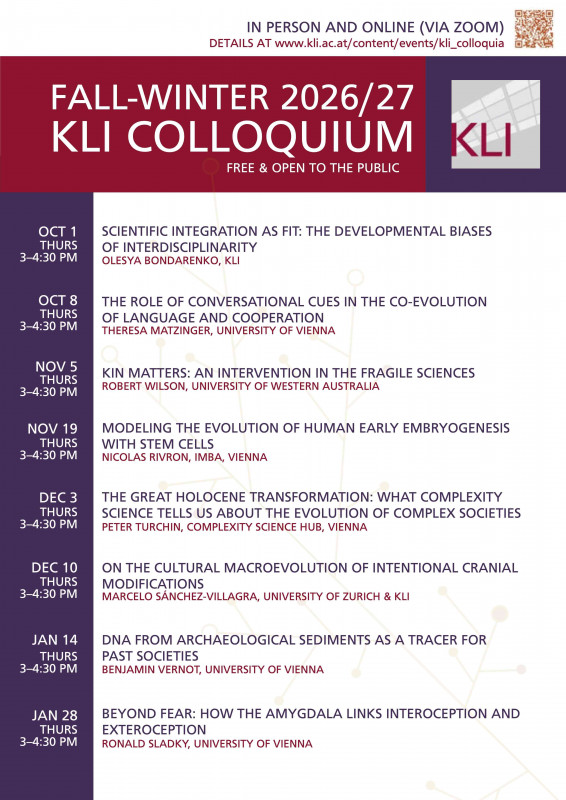
Scientific Integration as Fit: The Developmental Biases of Interdisciplinarity
Olesya BONDARENKO (KLI)
8 October 2026 (Thurs) 3-4:30 PM CET
The Role of Conversational Cues in the Co-Evolution of Language and Cooperation
Theresa MATZINGER (University of Vienna)
5 November 2026 (Thurs) 3-4:30 PM CET
Kin Matters: An Intervention in the Fragile Sciences
Robert A. WILSON (University of Western Australia)
19 November 2026 (Thurs) 3-4:30 PM CET
Modeling the Evolution of Human Early Embryogenesis with Stem Cells
Nicolas RIVRON (Institute of Molecular Biotechnology/IMBA, Vienna)
3 December 2026 (Thurs) 3-4:30 PM CET
Peter TURCHIN (Complexity Science Hub, Vienna)
10 December 2026 (Thurs) 3-4:30 PM CET
On the Cultural Macroevolution of Intentional Cranial Modifications
Marcelo SÁNCHEZ-VILLAGRA (University of Zurich)
14 January 2027 (Thurs) 3-4:30 PM CET
DNA from Archaeological Sediments as a Tracer for Past Societies
Benjamin VERNOT (University of Vienna)
28 January 2027 (Thurs) 3-4:30 PM CET
Beyond Fear: How the Amygdala Links Interoception and Exteroception
Ronald SLADKY (University of Vienna)
KLI Colloquia 2014 – 2026
Event Details
Topic description:
In his landmark book "Chance and Necessity: An Essay on the Natural Philosophy of Modern Biology," Jacques Monod seeks to articulate and then to resolve what he perceived to be a paradox afflicting modern biology: organisms both must be and can’t be purposive systems. The purposiveness of organisms, he claims, can by explained exhaustively by chance mutations to the otherwise invariant chemical basis of life: “Pure chance, absolutely free but blind, at the very root of the stupendous edifice of evolution” (Monod 1971: 112). In tracing evolutionary biology’s commitment to chance back to its methodological roots, Monod is echoing the Pre-Socratic atomist philosopher Democritus, who Monod credits with holding that everything in the world is the fruit of chance and necessity. Monod’s choice of philosophical avatar is apt and telling. Modern evolutionary biology is thoroughly neo-Democritean; like its atomist precursor, it allows no explanatory appeal to purposes. This, I maintain, is current evolutionary biology’s principal weakness. I attempt to develop in outline, a neo-Aristotelian conception of evolutionary biology, one that gives the purposiveness of organisms a central explanatory role.
Biographical note:
Denis Walsh is Canada Research Chair in Philosophy of Biology in the Department of Philosophy, the Institute for the History and Philosophy of Science and Technology, and the Department of Ecology and Evolutionary Biology, at the University of Toronto. He gained his PhDs from McGill University, and King's College London. His research interests are in the nature of biological explanation, evolutionary population dynamics, and the place of development in evolutionary theory. He is currently completing a book manuscript provisionally entitled "Organisms: A Philosophical Introduction."
