

KLI Colloquia are invited research talks of about an hour followed by 30 min discussion. The talks are held in English, open to the public, and offered in hybrid format.
Join via Zoom:
https://us02web.zoom.us/j/5881861923?omn=85945744831
Meeting ID: 588 186 1923
Fall-Winter 2026/27 KLI Colloquium Series
1 October 2026 (Thurs) 3-4:30 PM CET 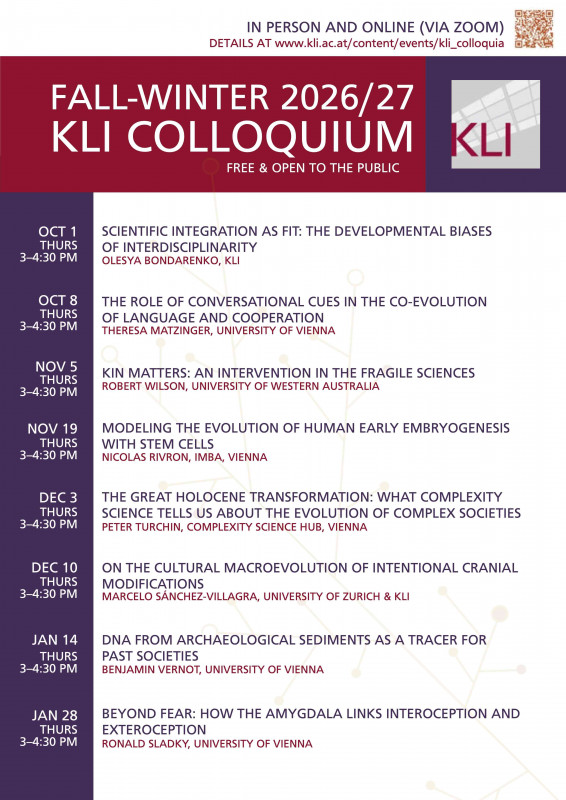
Scientific Integration as Fit: The Developmental Biases of Interdisciplinarity
Olesya BONDARENKO (KLI)
8 October 2026 (Thurs) 3-4:30 PM CET
The Role of Conversational Cues in the Co-Evolution of Language and Cooperation
Theresa MATZINGER (University of Vienna)
5 November 2026 (Thurs) 3-4:30 PM CET
Kin Matters: An Intervention in the Fragile Sciences
Robert A. WILSON (University of Western Australia)
19 November 2026 (Thurs) 3-4:30 PM CET
Modeling the Evolution of Human Early Embryogenesis with Stem Cells
Nicolas RIVRON (Institute of Molecular Biotechnology/IMBA, Vienna)
3 December 2026 (Thurs) 3-4:30 PM CET
Peter TURCHIN (Complexity Science Hub, Vienna)
10 December 2026 (Thurs) 3-4:30 PM CET
On the Cultural Macroevolution of Intentional Cranial Modifications
Marcelo SÁNCHEZ-VILLAGRA (University of Zurich)
14 January 2027 (Thurs) 3-4:30 PM CET
DNA from Archaeological Sediments as a Tracer for Past Societies
Benjamin VERNOT (University of Vienna)
28 January 2027 (Thurs) 3-4:30 PM CET
Beyond Fear: How the Amygdala Links Interoception and Exteroception
Ronald SLADKY (University of Vienna)
KLI Colloquia 2014 – 2026
Event Details
Topic description:
In this talk I will first argue why the concept of autonomy is of fundamental importance for building a unified view of what current biological knowledge presents as a highly complex and diverse world of phenomena. Second, I will briefly examine how the idea of autonomy was introduced and developed in biology. And third, I will analyze why --and how-- this “classical” concept of autonomy should be radically amended. In this last part I will pay attention especially to two questions: the relation between the individualized dimension where autonomy is embodied and its historical dimension; and the relation of individual realizations of autonomy with the interdependent, collective forms of organization.
Biographical note:
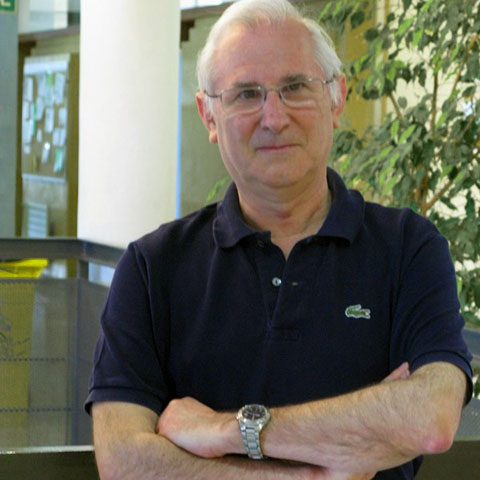
Alvaro Moreno is Professor of Philosophy of Science at the University of the Basque Country (UPV / EHU). He founded, more than 20 years ago, the Research Group in philosophy of biology IAS Research Center for Life, Mind & Society. A.M. has become one of the researchers of reference in Europe in the areas of philosophy of biology, artificial life, complex systems and cognitive science. He has authored more than 150 scientific publications (including 2 monographs and 4 edited volumes) and almost as many papers in national and international conferences.
