

KLI Colloquia are invited research talks of about an hour followed by 30 min discussion. The talks are held in English, open to the public, and offered in hybrid format.
Join via Zoom:
https://us02web.zoom.us/j/5881861923?omn=85945744831
Meeting ID: 588 186 1923
Fall-Winter 2026/27 KLI Colloquium Series
1 October 2026 (Thurs) 3-4:30 PM CET 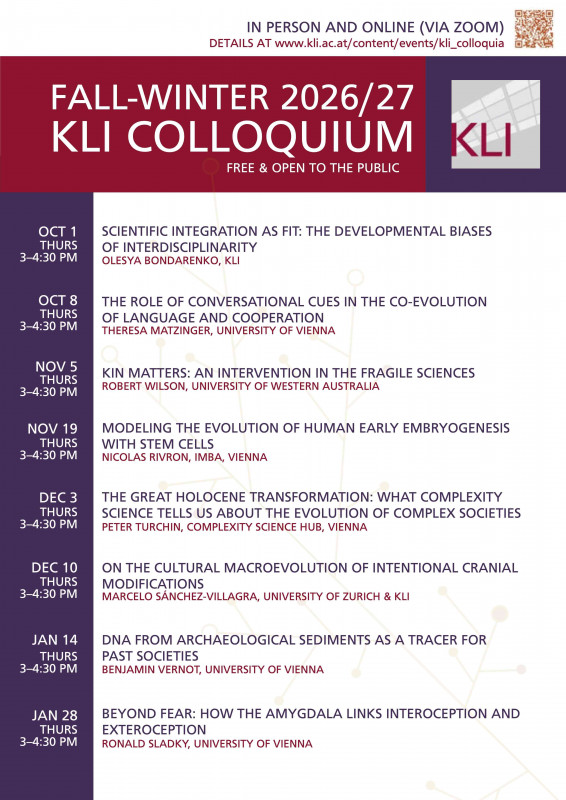
Scientific Integration as Fit: The Developmental Biases of Interdisciplinarity
Olesya BONDARENKO (KLI)
8 October 2026 (Thurs) 3-4:30 PM CET
The Role of Conversational Cues in the Co-Evolution of Language and Cooperation
Theresa MATZINGER (University of Vienna)
5 November 2026 (Thurs) 3-4:30 PM CET
Kin Matters: An Intervention in the Fragile Sciences
Robert A. WILSON (University of Western Australia)
19 November 2026 (Thurs) 3-4:30 PM CET
Modeling the Evolution of Human Early Embryogenesis with Stem Cells
Nicolas RIVRON (Institute of Molecular Biotechnology/IMBA, Vienna)
3 December 2026 (Thurs) 3-4:30 PM CET
Peter TURCHIN (Complexity Science Hub, Vienna)
10 December 2026 (Thurs) 3-4:30 PM CET
On the Cultural Macroevolution of Intentional Cranial Modifications
Marcelo SÁNCHEZ-VILLAGRA (University of Zurich)
14 January 2027 (Thurs) 3-4:30 PM CET
DNA from Archaeological Sediments as a Tracer for Past Societies
Benjamin VERNOT (University of Vienna)
28 January 2027 (Thurs) 3-4:30 PM CET
Beyond Fear: How the Amygdala Links Interoception and Exteroception
Ronald SLADKY (University of Vienna)
KLI Colloquia 2014 – 2026
Event Details
Topic description:
Today, peer review is one of the most common practices in scientific affairs. Scientists spend a good share of their professional work either for writing manuscripts or proposals to be reviewed, or for reviewing their peers’ submissions. Peer review is also highly charged with meaning: to some, it lies at the very heart of scientific culture, while others are quite critical about it. Despite its importance in the daily routine of most researchers, and its perceived relevance for science in general, it is surprising how little conceptual discussion, and even analytical reflection, peer review has received so far. While there is an increasing number of studies, either assessing the quality of certain peer review procedures as implemented by funding agencies and journals alike, or investigating the inner workings of what is often called the “black box” peer review, these studies have done little to enhance our analytical understanding of what peer review is. In this presentation, I offer a conceptualization of peer review that aims at providing exactly this analytical understanding. It starts with distinguishing between peer review as a principle of decision-making, and peer review as a procedure to ensure robust results. It then turns to different deployments of the principle, and the consequences for its respective procedural implementation. From this differentiated concept, it becomes clear that “peer review” actually achieves justification of decisions made in the name of science. Understanding how peer review works helps us to better grasp its persistence despite many doubts and inconsistencies; it could also open a way to think more profoundly about possible ways to substantially improve the procedure, and about possible alternatives.
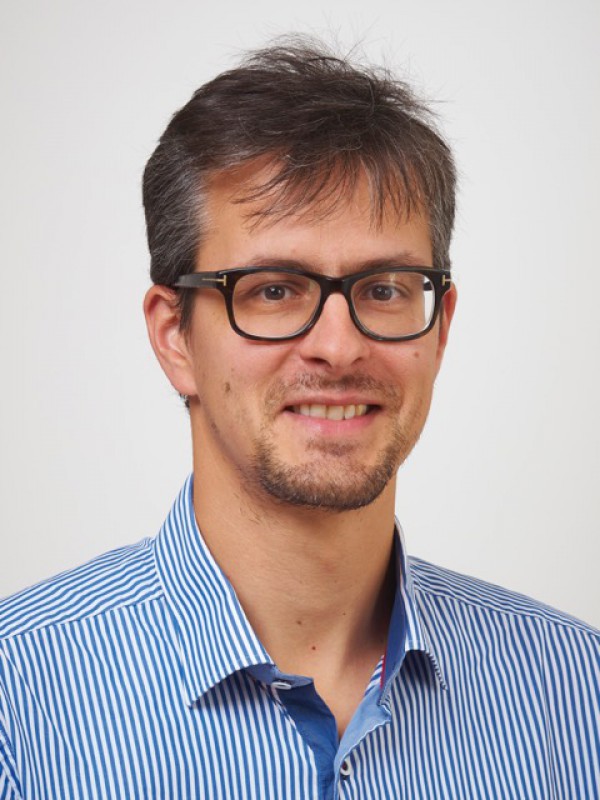
Biographical note:
Between 1994 and 2001, I studied political science and history at the Universities of Vienna and Copenhagen. After a few years outside academia, I returned to the University of Vienna, where, between 2006 and 2010 I was tasked to establish and manage the “Graduiertenzentrum Sowi” at, the first institutional center to support PhD candidates at an Austrian University. From this period stems my dual fascination in organizing (and managing) science, on the one hand, and reflecting upon it. This is already reflected in my dissertation, which investigated the impact of an academic exchange program, the Fulbright Program, on Austrian post-war academia. The dissertation was submitted and defended with distinction in 2009; a shortened and improved version was published in 2012 (in German). My interest both in understanding scientific practices and enabling them was particularly helpful when, between 2010 and 2013, I was scientific advisor to the President of the European Research Council (ERC), Helga Nowotny. Towards the end of that time, I decided to write a book on my personal experiences with the politics of research funding, and the role of peer review, in particular. In 2014, I went to Michèle Lamont at Harvard University to study her sociology of values and valuation. Since 2015, I am a researcher at the Institute for Advanced Studies in Vienna (IHS). My book “The European Research Council” has been published with Polity Press in Jan 2017.
