

KLI Colloquia are invited research talks of about an hour followed by 30 min discussion. The talks are held in English, open to the public, and offered in hybrid format.
Join via Zoom:
https://us02web.zoom.us/j/5881861923?omn=85945744831
Meeting ID: 588 186 1923
Fall-Winter 2026/27 KLI Colloquium Series
1 October 2026 (Thurs) 3-4:30 PM CET 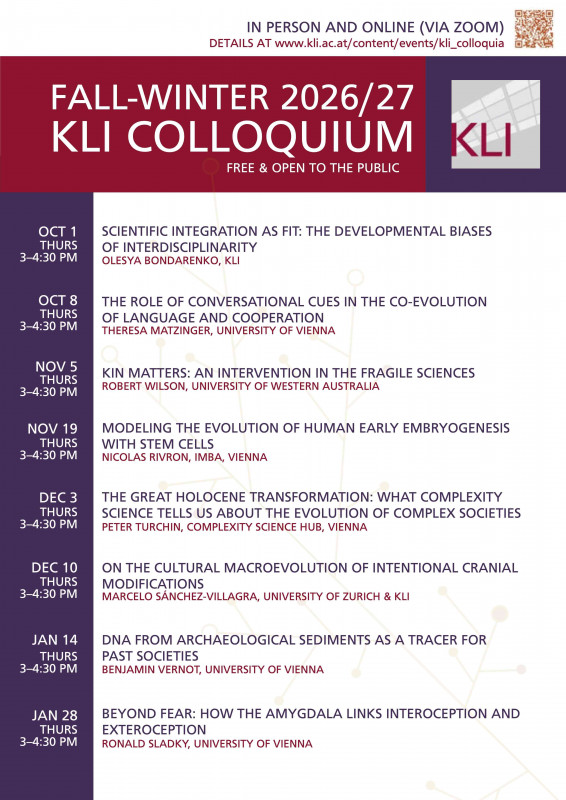
Scientific Integration as Fit: The Developmental Biases of Interdisciplinarity
Olesya BONDARENKO (KLI)
8 October 2026 (Thurs) 3-4:30 PM CET
The Role of Conversational Cues in the Co-Evolution of Language and Cooperation
Theresa MATZINGER (University of Vienna)
5 November 2026 (Thurs) 3-4:30 PM CET
Kin Matters: An Intervention in the Fragile Sciences
Robert A. WILSON (University of Western Australia)
19 November 2026 (Thurs) 3-4:30 PM CET
Modeling the Evolution of Human Early Embryogenesis with Stem Cells
Nicolas RIVRON (Institute of Molecular Biotechnology/IMBA, Vienna)
3 December 2026 (Thurs) 3-4:30 PM CET
Peter TURCHIN (Complexity Science Hub, Vienna)
10 December 2026 (Thurs) 3-4:30 PM CET
On the Cultural Macroevolution of Intentional Cranial Modifications
Marcelo SÁNCHEZ-VILLAGRA (University of Zurich)
14 January 2027 (Thurs) 3-4:30 PM CET
DNA from Archaeological Sediments as a Tracer for Past Societies
Benjamin VERNOT (University of Vienna)
28 January 2027 (Thurs) 3-4:30 PM CET
Beyond Fear: How the Amygdala Links Interoception and Exteroception
Ronald SLADKY (University of Vienna)
KLI Colloquia 2014 – 2026
Event Details
Topic description:
From its very beginnings Molecular Biology focused on simple enough model systems that captured the essential complexity of biology, in order to extract the general molecular mechanisms underlying the functioning of the cell. Similarly Systems Biology and Synthetic Biology have benefited from the use of simple model systems. I will introduce examples of such experimental model systems and show how even the simplest of model systems in Systems and Synthetic Biology can be used to unravel open fundamental questions of biology.
Biographical note:
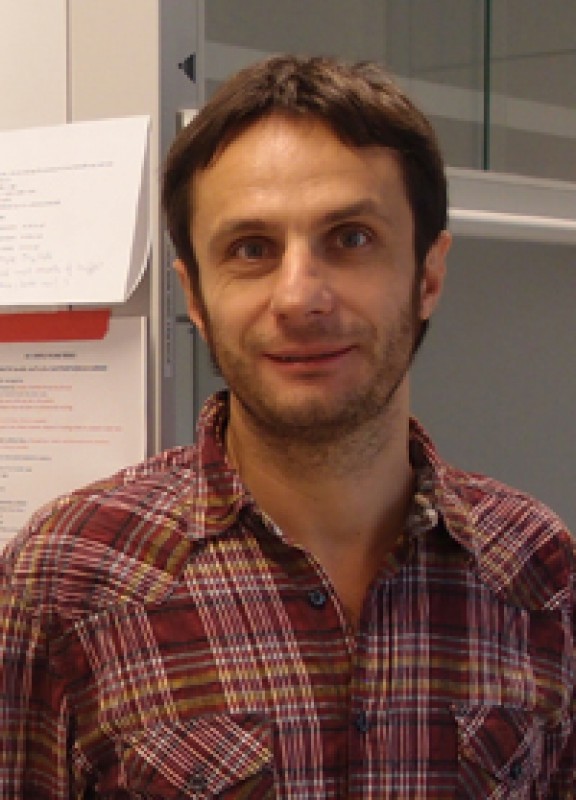
Calin Guet studied Physics and Molecular Biology at Princeton University as an undergraduate. He did his PhD with Stanislas Leibler at Princeton University and the Rockefeller University, working on the early basis of what is now Systems and Synthetic Biology. After postdoctoral work at the University of Chicago and Harvard on the single-cell biology of bacteria, he moved to IST Austria where he started his own research group working on questions that lie at the interface of Ecology, Evolution, Molecular Biology and Physiology of bacteria and phages.
