

KLI Colloquia are invited research talks of about an hour followed by 30 min discussion. The talks are held in English, open to the public, and offered in hybrid format.
Join via Zoom:
https://us02web.zoom.us/j/5881861923?omn=85945744831
Meeting ID: 588 186 1923
Fall-Winter 2026/27 KLI Colloquium Series
1 October 2026 (Thurs) 3-4:30 PM CET 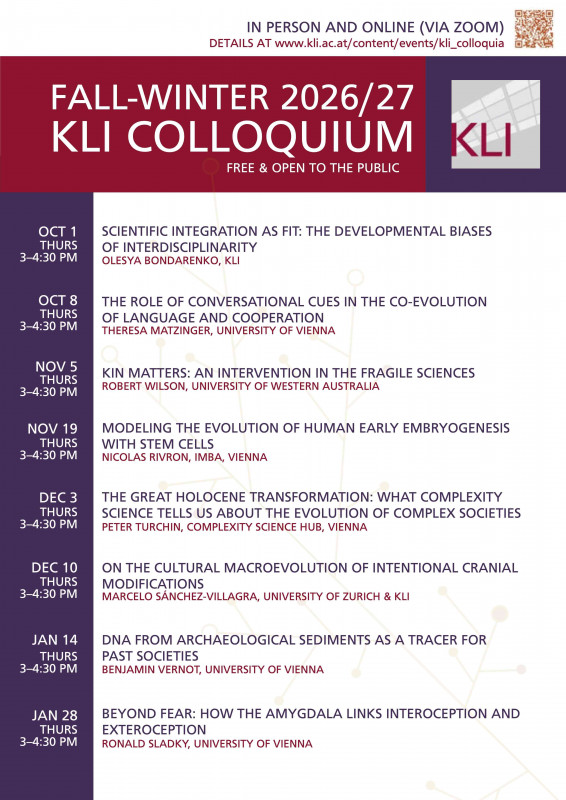
Scientific Integration as Fit: The Developmental Biases of Interdisciplinarity
Olesya BONDARENKO (KLI)
8 October 2026 (Thurs) 3-4:30 PM CET
The Role of Conversational Cues in the Co-Evolution of Language and Cooperation
Theresa MATZINGER (University of Vienna)
5 November 2026 (Thurs) 3-4:30 PM CET
Kin Matters: An Intervention in the Fragile Sciences
Robert A. WILSON (University of Western Australia)
19 November 2026 (Thurs) 3-4:30 PM CET
Modeling the Evolution of Human Early Embryogenesis with Stem Cells
Nicolas RIVRON (Institute of Molecular Biotechnology/IMBA, Vienna)
3 December 2026 (Thurs) 3-4:30 PM CET
Peter TURCHIN (Complexity Science Hub, Vienna)
10 December 2026 (Thurs) 3-4:30 PM CET
On the Cultural Macroevolution of Intentional Cranial Modifications
Marcelo SÁNCHEZ-VILLAGRA (University of Zurich)
14 January 2027 (Thurs) 3-4:30 PM CET
DNA from Archaeological Sediments as a Tracer for Past Societies
Benjamin VERNOT (University of Vienna)
28 January 2027 (Thurs) 3-4:30 PM CET
Beyond Fear: How the Amygdala Links Interoception and Exteroception
Ronald SLADKY (University of Vienna)
KLI Colloquia 2014 – 2026
Event Details

Topic description:
Western conceptions of individuality have been dominated by the substance traditions’ emphases on independence. Whether an individual is defined by its essential independence, as with Aristotle, or by its existential independence, as with Descartes, it is the distinctness, separateness that is the mark of the individual. Further, the denotation of individuality has been dominated by sight, which locates individuality through boundaries that are observable at human spatial and temporal scales. Individuals are visually identifiable by their skin or some other membrane. In the modern era, this ontology of individuality as independence often brought about corresponding emphases in the domains of ethics, law, and politics, where concepts such as freedom, responsibility, and autonomy came to dominate. In contradistinction to these dominant ontological traditions, in this presentation I will argue that there is no independence of existence; to exist is to be a constitutively interrelated process. Specifically, using examples of macrotermes termites, I will argue that individuality is ultimately a matter of degree, more or less, and is not best determined by visually identifiable boundaries. I conclude that the ontology of individuality must be fundamentally reconceived along the lines of an organicist process metaphysics. A brief discussion of the ethical implications of this ontological shift will be included, time permitting.
Biographical note:
Brian G. Henning is Professor of Philosophy and Environmental Studies at Gonzaga University in Spokane, Washington (USA) where he serves as the Faculty Fellow for Sustainability. He is the Founding Executive Editor of the Edinburgh Critical Edition of the Complete Works of Alfred North Whitehead. His research includes more than thirty articles and seven books and edited volumes, including Beyond Metaphysics? Explorations in Alfred North Whitehead’s Late Thought, Beyond Mechanism: Putting Life Back Into Biology, and Thinking with Whitehead and American Pragmatists. His 2005 book, The Ethics of Creativity, won the Findlay Book Prize from the Metaphysical Society of America and was named a “Top Ten Pick” by Foreword magazine. He is currently working on a book on environmental metaphysics. http://connect.gonzaga.edu/henning/
