

KLI Colloquia are invited research talks of about an hour followed by 30 min discussion. The talks are held in English, open to the public, and offered in hybrid format.
Join via Zoom:
https://us02web.zoom.us/j/5881861923?omn=85945744831
Meeting ID: 588 186 1923
Fall-Winter 2026/27 KLI Colloquium Series
1 October 2026 (Thurs) 3-4:30 PM CET 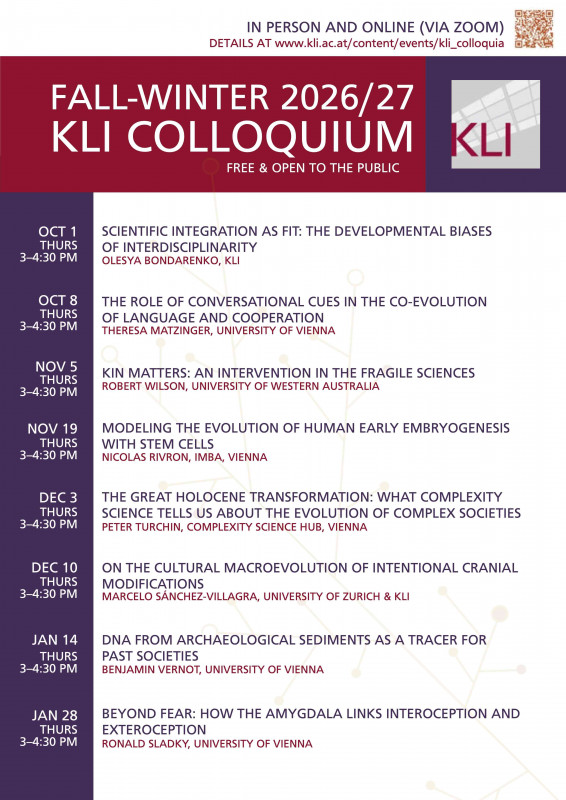
Scientific Integration as Fit: The Developmental Biases of Interdisciplinarity
Olesya BONDARENKO (KLI)
8 October 2026 (Thurs) 3-4:30 PM CET
The Role of Conversational Cues in the Co-Evolution of Language and Cooperation
Theresa MATZINGER (University of Vienna)
5 November 2026 (Thurs) 3-4:30 PM CET
Kin Matters: An Intervention in the Fragile Sciences
Robert A. WILSON (University of Western Australia)
19 November 2026 (Thurs) 3-4:30 PM CET
Modeling the Evolution of Human Early Embryogenesis with Stem Cells
Nicolas RIVRON (Institute of Molecular Biotechnology/IMBA, Vienna)
3 December 2026 (Thurs) 3-4:30 PM CET
Peter TURCHIN (Complexity Science Hub, Vienna)
10 December 2026 (Thurs) 3-4:30 PM CET
On the Cultural Macroevolution of Intentional Cranial Modifications
Marcelo SÁNCHEZ-VILLAGRA (University of Zurich)
14 January 2027 (Thurs) 3-4:30 PM CET
DNA from Archaeological Sediments as a Tracer for Past Societies
Benjamin VERNOT (University of Vienna)
28 January 2027 (Thurs) 3-4:30 PM CET
Beyond Fear: How the Amygdala Links Interoception and Exteroception
Ronald SLADKY (University of Vienna)
KLI Colloquia 2014 – 2026
Event Details

Topic description:
The coupling between compartment and metabolic dynamics is one of the central features that define all living organisms, as intrinsically cellular systems. Given the complexity of such a coupling in any extant cell, I will take a genealogical approach to the problem. This involves moving from biology to chemistry; but not any kind of chemistry. I consider that the recently emerged field of systems chemistry, which studies diverse mixtures of organic molecules in interaction, constitutes the most appropriate current platform to study the appearance and early development of prebiotic phenomena. It proposes a chemical scenario for the origins of life that is completely different from the ‘established view’ (i.e., the RNA-world view), which assumes that populations of naked biopolymers could evolve directly from chemistry and then, thanks to natural selection, towards living entities. Instead, systems chemistry pays attention to primitive forms of protocellular organization, as a much more plausible prebiotic pathway. In this context, my aims are: (i) to describe a crudely simplified protocol model that illustrates how this basic coupling between chemistry and compartment could have started taking shape in the primitive Earth; and (ii) by means of (i), explore whether this could provide new insights into the problem of characterising biological individuality and function in a minimal sense. Thus, I will try to show how research in chemistry could actually contribute to the naturalization of fundamental ideas for biology, like function and individuality.
Biographical note:
- Bachelor in Biology and Masters in Molecular Biology and Biomedicine at University of Basque Country (UPV-EHU)
- Currently a PhD student in Philosophy of Science within the IAS-Research Group (http://www.iasresearch.net/) and the Biofisika Institute (http://biofisika.org/) within a project called “Searching for the roots of biological function and individuality from a 'systems chemistry' approach” under the supervision of Dr. Kepa Ruiz-Mirazo.
- Part of the experimental work carried out during my PhD was done in collaboration with the group of Prof. Robert Pascal at the University of Montpellier (UM2/CRNS), France.
- KLI ‘Writing-Up’ Fellow (Oct 2016 - Mar 2017).
