

KLI Colloquia are invited research talks of about an hour followed by 30 min discussion. The talks are held in English, open to the public, and offered in hybrid format.
Join via Zoom:
https://us02web.zoom.us/j/5881861923?omn=85945744831
Meeting ID: 588 186 1923
Fall-Winter 2026/27 KLI Colloquium Series
1 October 2026 (Thurs) 3-4:30 PM CET 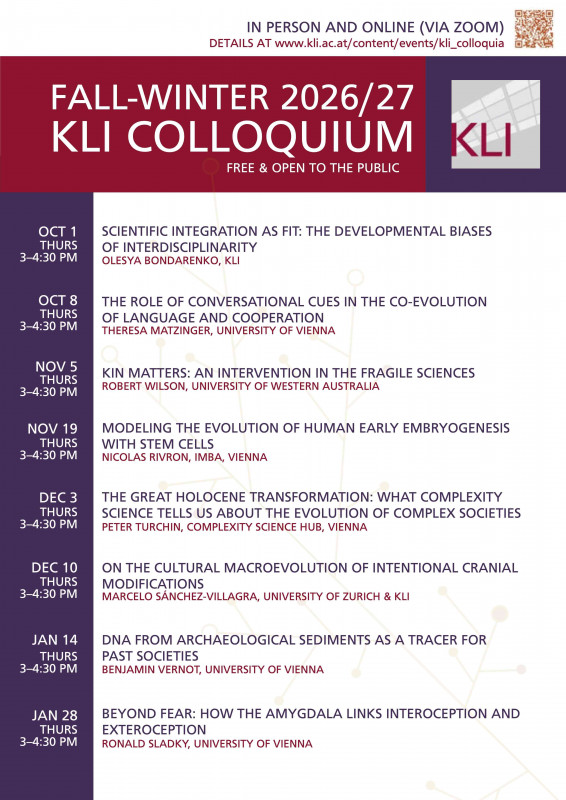
Scientific Integration as Fit: The Developmental Biases of Interdisciplinarity
Olesya BONDARENKO (KLI)
8 October 2026 (Thurs) 3-4:30 PM CET
The Role of Conversational Cues in the Co-Evolution of Language and Cooperation
Theresa MATZINGER (University of Vienna)
5 November 2026 (Thurs) 3-4:30 PM CET
Kin Matters: An Intervention in the Fragile Sciences
Robert A. WILSON (University of Western Australia)
19 November 2026 (Thurs) 3-4:30 PM CET
Modeling the Evolution of Human Early Embryogenesis with Stem Cells
Nicolas RIVRON (Institute of Molecular Biotechnology/IMBA, Vienna)
3 December 2026 (Thurs) 3-4:30 PM CET
Peter TURCHIN (Complexity Science Hub, Vienna)
10 December 2026 (Thurs) 3-4:30 PM CET
On the Cultural Macroevolution of Intentional Cranial Modifications
Marcelo SÁNCHEZ-VILLAGRA (University of Zurich)
14 January 2027 (Thurs) 3-4:30 PM CET
DNA from Archaeological Sediments as a Tracer for Past Societies
Benjamin VERNOT (University of Vienna)
28 January 2027 (Thurs) 3-4:30 PM CET
Beyond Fear: How the Amygdala Links Interoception and Exteroception
Ronald SLADKY (University of Vienna)
KLI Colloquia 2014 – 2026
Event Details

Topic description:
Miniaturization is a phylogenetic concept defined as the evolution of unusually small adult size in a lineage, reaching beyond a threshold at which dramatic changes in morphology, physiology, and ecology occur. Because extreme size reduction may trigger substantial morphological changes that represent a pool of alternative morphological designs available for subsequent evolutionary diversification, miniaturization has been proposed as a key factor for the phyletic diversification above the species level and the origin of several major tetrapod clades. In this talk I will argue that in most cases the causal relationship between miniaturization and radical morphological changes has not been satisfactory explained because of the disregard of ontogenetic and phylogenetic aspects, obscuring our knowledge of the impact of miniaturization at the macroevolutionary level. In this context, I will discuss the putative role of miniaturization in the origin of lissamphibians (i.e., salamanders, frogs, and caecilians) within a clade of dwarfed Paleozoic temnospondyls.
Biographical note:
Celeste Pérez Ben holds a Master’s degree in Biology from the University of Buenos Aires, where she is currently a PhD candidate under the supervision of Ana Báez and Rainer Schoch. She carried out most of her doctoral research at the Staatliches Museum für Naturkunde Stuttgart and now she is finishing her dissertation at the KLI with a Writing-up fellowship.
