

KLI Colloquia are invited research talks of about an hour followed by 30 min discussion. The talks are held in English, open to the public, and offered in hybrid format.
Join via Zoom:
https://us02web.zoom.us/j/5881861923?omn=85945744831
Meeting ID: 588 186 1923
Fall-Winter 2026/27 KLI Colloquium Series
1 October 2026 (Thurs) 3-4:30 PM CET 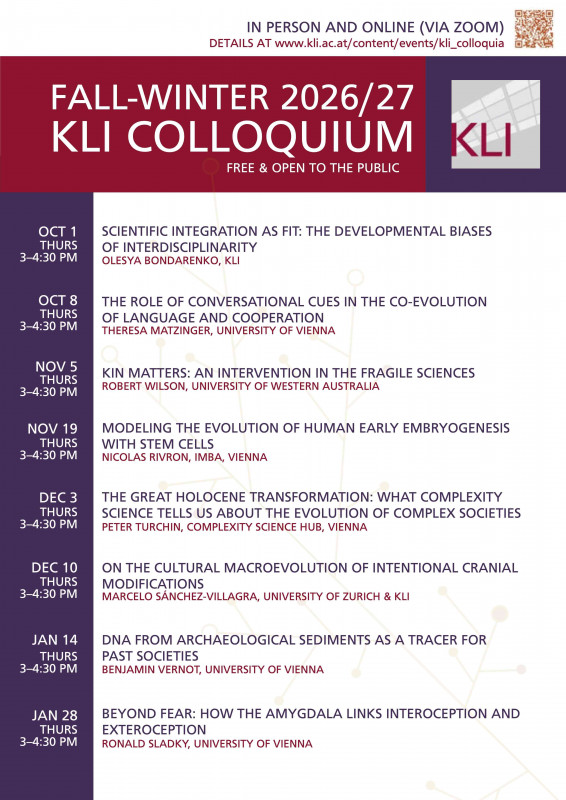
Scientific Integration as Fit: The Developmental Biases of Interdisciplinarity
Olesya BONDARENKO (KLI)
8 October 2026 (Thurs) 3-4:30 PM CET
The Role of Conversational Cues in the Co-Evolution of Language and Cooperation
Theresa MATZINGER (University of Vienna)
5 November 2026 (Thurs) 3-4:30 PM CET
Kin Matters: An Intervention in the Fragile Sciences
Robert A. WILSON (University of Western Australia)
19 November 2026 (Thurs) 3-4:30 PM CET
Modeling the Evolution of Human Early Embryogenesis with Stem Cells
Nicolas RIVRON (Institute of Molecular Biotechnology/IMBA, Vienna)
3 December 2026 (Thurs) 3-4:30 PM CET
Peter TURCHIN (Complexity Science Hub, Vienna)
10 December 2026 (Thurs) 3-4:30 PM CET
On the Cultural Macroevolution of Intentional Cranial Modifications
Marcelo SÁNCHEZ-VILLAGRA (University of Zurich)
14 January 2027 (Thurs) 3-4:30 PM CET
DNA from Archaeological Sediments as a Tracer for Past Societies
Benjamin VERNOT (University of Vienna)
28 January 2027 (Thurs) 3-4:30 PM CET
Beyond Fear: How the Amygdala Links Interoception and Exteroception
Ronald SLADKY (University of Vienna)
KLI Colloquia 2014 – 2026
Event Details

Topic description:
In the 157 years since Darwin’s Origin of Species, biologists have developed sophisticated ways to uncover and study the hidden shared ancestry of all life from genetic data. While Darwin was able to formulate his ideas without using mathematics, he later wrote how he regretted not having studied that subject further. Mathematics has since become an essential tool that allows biologists to tease apart evolutionary signal from noise and bias in data, and to build reliable phylogenetic trees and networks. Biologists use these trees widely: for example, to classify new species, trace human migrations, and to help predict next year’s influenza strain. In this talk, I provide an overview of how ideas from mathematics have become central to the study and visualizing of evolution.
Biographical note:
Mike Steel is professor of mathematics and director of the Biomathematics Research Centre at the University of Canterbury, Christchurch, New Zealand. His research interests include combinatorics, stochastic processes, and applications in evolutionary biology and related areas. He is an elected fellow of the Royal Society of New Zealand and has around 240 research publications, including two books on mathematical phylogenetics (2003, 2016).
