

KLI Colloquia are invited research talks of about an hour followed by 30 min discussion. The talks are held in English, open to the public, and offered in hybrid format.
Join via Zoom:
https://us02web.zoom.us/j/5881861923?omn=85945744831
Meeting ID: 588 186 1923
Fall-Winter 2026/27 KLI Colloquium Series
1 October 2026 (Thurs) 3-4:30 PM CET 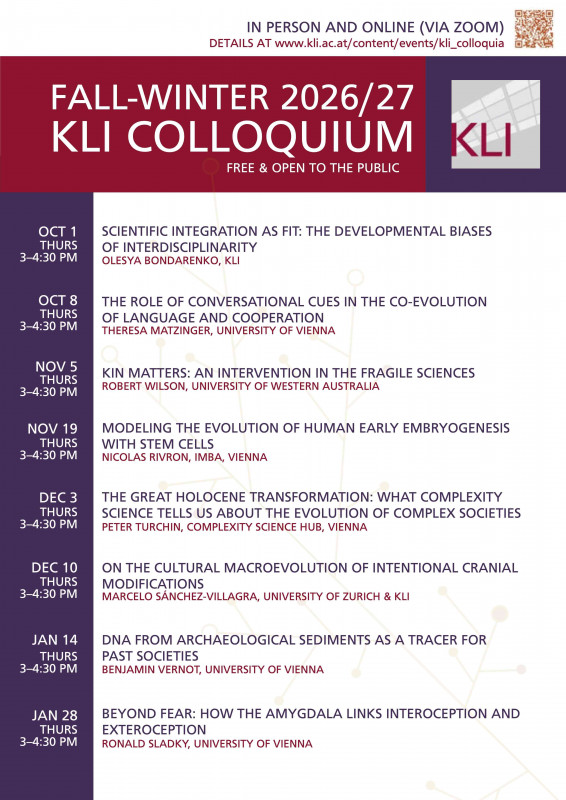
Scientific Integration as Fit: The Developmental Biases of Interdisciplinarity
Olesya BONDARENKO (KLI)
8 October 2026 (Thurs) 3-4:30 PM CET
The Role of Conversational Cues in the Co-Evolution of Language and Cooperation
Theresa MATZINGER (University of Vienna)
5 November 2026 (Thurs) 3-4:30 PM CET
Kin Matters: An Intervention in the Fragile Sciences
Robert A. WILSON (University of Western Australia)
19 November 2026 (Thurs) 3-4:30 PM CET
Modeling the Evolution of Human Early Embryogenesis with Stem Cells
Nicolas RIVRON (Institute of Molecular Biotechnology/IMBA, Vienna)
3 December 2026 (Thurs) 3-4:30 PM CET
Peter TURCHIN (Complexity Science Hub, Vienna)
10 December 2026 (Thurs) 3-4:30 PM CET
On the Cultural Macroevolution of Intentional Cranial Modifications
Marcelo SÁNCHEZ-VILLAGRA (University of Zurich)
14 January 2027 (Thurs) 3-4:30 PM CET
DNA from Archaeological Sediments as a Tracer for Past Societies
Benjamin VERNOT (University of Vienna)
28 January 2027 (Thurs) 3-4:30 PM CET
Beyond Fear: How the Amygdala Links Interoception and Exteroception
Ronald SLADKY (University of Vienna)
KLI Colloquia 2014 – 2026
Event Details
Topic description:
In almost all domains of the life sciences, major historical debates are dominated by a division between internalists vs. externalists schools of thought (Gould 1977, Wilson 2004, 2005, Godfrey-Smith 1996, Bechtel and Richardson 1993/2010). Internalists and externalists have argued over nature (genetics) vs. nurture (culture), the content and vehicles of mental states, the causes of biological forms and function, the sources of adaptive evolution, the specification of immune self-recognition, the development of language, etc.
In this talk, I sketch out the basis of a future research proposal. The goal is to identify and characterize a general principle in biology and show how it can reconcile the internal vs. external dichotomy. The principle is that living systems, through their activities, explorations, and modes of interactions (“enabling causes”), tend to actively create the internal and external conditions that in turn enable “constitutive causes” to come together and give rise to biological form, function, and relative fitness.
The project will consist of two parts. First, I will focus on historical episodes in immunology and cancer biology, where internalist vs. externalist camps have argued over the ultimate cause of cellular identity. I will seek out “middle-ground” positions that have been sidelined or mischaracterized as merely interactive or purely internal/external, but in fact provide what I call “enabling causes” that defy the internal vs. external distinction. I then lay out how to test the generality of this “enabling” principle of biology and draw out its consequences for debates about biological identity.
Biographical note:
