

KLI Colloquia are invited research talks of about an hour followed by 30 min discussion. The talks are held in English, open to the public, and offered in hybrid format.
Join via Zoom:
https://us02web.zoom.us/j/5881861923?omn=85945744831
Meeting ID: 588 186 1923
Fall-Winter 2026/27 KLI Colloquium Series
1 October 2026 (Thurs) 3-4:30 PM CET 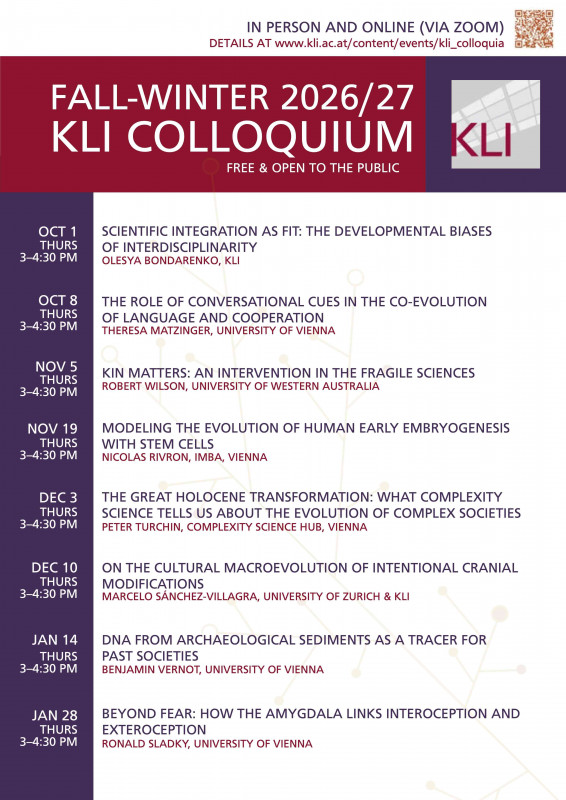
Scientific Integration as Fit: The Developmental Biases of Interdisciplinarity
Olesya BONDARENKO (KLI)
8 October 2026 (Thurs) 3-4:30 PM CET
The Role of Conversational Cues in the Co-Evolution of Language and Cooperation
Theresa MATZINGER (University of Vienna)
5 November 2026 (Thurs) 3-4:30 PM CET
Kin Matters: An Intervention in the Fragile Sciences
Robert A. WILSON (University of Western Australia)
19 November 2026 (Thurs) 3-4:30 PM CET
Modeling the Evolution of Human Early Embryogenesis with Stem Cells
Nicolas RIVRON (Institute of Molecular Biotechnology/IMBA, Vienna)
3 December 2026 (Thurs) 3-4:30 PM CET
Peter TURCHIN (Complexity Science Hub, Vienna)
10 December 2026 (Thurs) 3-4:30 PM CET
On the Cultural Macroevolution of Intentional Cranial Modifications
Marcelo SÁNCHEZ-VILLAGRA (University of Zurich)
14 January 2027 (Thurs) 3-4:30 PM CET
DNA from Archaeological Sediments as a Tracer for Past Societies
Benjamin VERNOT (University of Vienna)
28 January 2027 (Thurs) 3-4:30 PM CET
Beyond Fear: How the Amygdala Links Interoception and Exteroception
Ronald SLADKY (University of Vienna)
KLI Colloquia 2014 – 2026
Event Details

Topic description / abstract:
Some authors have recently argued that moral facts are facts about the conditions and practices that support or undermine cooperation. This view is often stated as a moderate version of moral realism in which selection for tracking facts about cooperation is only one causal thread in the evolution of morality. In this talk, I argue that, if such a view is on the right track, our metaethical judgments about the objectivity of moral disagreements should increase the expected cooperative output rather than merely coordinate our normative beliefs. This corollary is supported by psychological evidence showing that people tend to judge moral disagreements as being less objective when the cultural distance between the parties in disagreement increases. I suggest that such an effect could be understood as an adaptation for cooperation under the assumption (yet to proved) that cooperative behavior is more likely when our perception of the objectivity of a normative disagreement decreases. Finally, I put forward some possible ways to test this hypothesis and discuss the implications of getting similar results across other normative domains such as religion and politics. I suggest that selection for truth-tracking facts about cooperation might be a causal thread that is common to our social normative psychology rather than a distinctive feature of the evolution of our moral cognition.
Biographical note:
Ivan Gonzalez-Cabrera is a Post-doctoral Fellow at the Konrad Lorenz Institute for Evolution and Cognition Research (KLI). He studied human ecology at the University of Tokyo and did his Ph.D. in Philosophy at the Australian National University under Professor Kim Sterelny's supervision. Before joining the KLI, he was Research Fellow in Michael Tomasello’s lab at the Max Planck Institute for Evolutionary Anthropology, Visiting Fellow at the Cognitive Science Center of the University of Tubingen, and KLI Writing-Up Fellow. His research focuses on the intersection between biology and psychology, and their philosophical implications. Most of his previous work has been concerned with issues about normative cognition, with a secondary interest in causal and physical cognition. As a KLI Postdoctoral Fellow, he is currently working on normative disagreement and its role in the emergence of large-scale cooperation in humans.
