

KLI Colloquia are invited research talks of about an hour followed by 30 min discussion. The talks are held in English, open to the public, and offered in hybrid format.
Join via Zoom:
https://us02web.zoom.us/j/5881861923?omn=85945744831
Meeting ID: 588 186 1923
Fall-Winter 2026/27 KLI Colloquium Series
1 October 2026 (Thurs) 3-4:30 PM CET 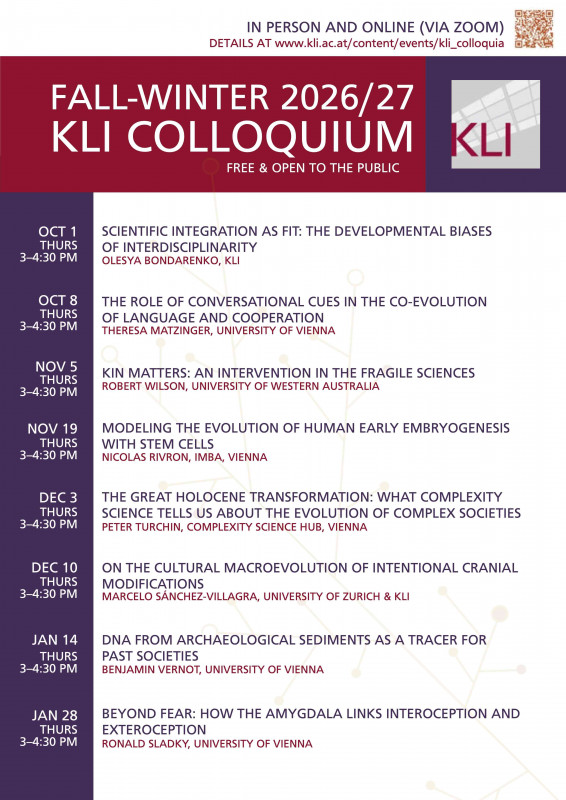
Scientific Integration as Fit: The Developmental Biases of Interdisciplinarity
Olesya BONDARENKO (KLI)
8 October 2026 (Thurs) 3-4:30 PM CET
The Role of Conversational Cues in the Co-Evolution of Language and Cooperation
Theresa MATZINGER (University of Vienna)
5 November 2026 (Thurs) 3-4:30 PM CET
Kin Matters: An Intervention in the Fragile Sciences
Robert A. WILSON (University of Western Australia)
19 November 2026 (Thurs) 3-4:30 PM CET
Modeling the Evolution of Human Early Embryogenesis with Stem Cells
Nicolas RIVRON (Institute of Molecular Biotechnology/IMBA, Vienna)
3 December 2026 (Thurs) 3-4:30 PM CET
Peter TURCHIN (Complexity Science Hub, Vienna)
10 December 2026 (Thurs) 3-4:30 PM CET
On the Cultural Macroevolution of Intentional Cranial Modifications
Marcelo SÁNCHEZ-VILLAGRA (University of Zurich)
14 January 2027 (Thurs) 3-4:30 PM CET
DNA from Archaeological Sediments as a Tracer for Past Societies
Benjamin VERNOT (University of Vienna)
28 January 2027 (Thurs) 3-4:30 PM CET
Beyond Fear: How the Amygdala Links Interoception and Exteroception
Ronald SLADKY (University of Vienna)
KLI Colloquia 2014 – 2026
Event Details

Topic description / abstract:
Cybernetics is often said to have originated in the years of WWII thanks to the works of scientists that first tried to describe automated systems and their behaviour. The success of cybernetics is associated with the theory of servomechanisms that provided underlying principles to connect information systems, systems biology and computer sciences into a broader interdisciplinary theoretical framework. This theory was aimed to be applied to the physical and mathematical study of self-organisation and purposiveness in living organisms and machines, but soon after the 1940s it spread beyond the den of these first cybernetic studies and led to the foundation of the biological systems approach, profitably applied in molecular biology, genetics, genomics, immunology, developmental biology, and ecology. While the importance of cybernetics is still frequently emphasized in engineering and telecommunication studies, it is very much overlooked in biology. Theoretical literature lacks a clear account of the type of methodology, epistemology and ontology that cybernetics involves, and in particular of the impact that this latter had for the development of the life sciences. This presentation argues that cybernetic thinking involves two types of commitments: A reductionistic one that received major attention in the biology and philosophy of biology literature, though whose influence on modern biology has been largely misunderstood as mechanistic; and a second type, antireductionism, which has had an important impact on modern biology, but has been completely overlooked in the philosophy of biology literature. This work aims at clarifying cybernetic research tradition to discuss how it has shaped the history of the life sciences and led to the novel conceptions of modern biology that are in practice today, which transcend mechanistic explanatory frameworks.
Biographical note:
Flavia Fabris is a research fellow at the KLI. She is a philosopher of biology with a background in philosophy of science and evolutionary developmental biology. Her research examines a variety of conceptual issues in evolutionary and developmental biology, with an emphasis on methodological and ontological aspects of scientific practice. At present, her work is on the history and philosophy of cybernetics, its primary forms of reasoning, and its implications for theoretical biology, with particular regard to evo-devo and the Extended Evolutionary Synthesis. From 2011 until 2014 she worked at the La Sapienza Department of Genetics and Molecular Biology “Charles Darwin”, doing empirical work on epigenetic inheritance and the canalization of development. Since 2014 she has been research fellow at Egenis, the Centre for the Study of Life Sciences, at the University of Exeter.
