

KLI Colloquia are invited research talks of about an hour followed by 30 min discussion. The talks are held in English, open to the public, and offered in hybrid format.
Join via Zoom:
https://us02web.zoom.us/j/5881861923?omn=85945744831
Meeting ID: 588 186 1923
Fall-Winter 2026/27 KLI Colloquium Series
1 October 2026 (Thurs) 3-4:30 PM CET 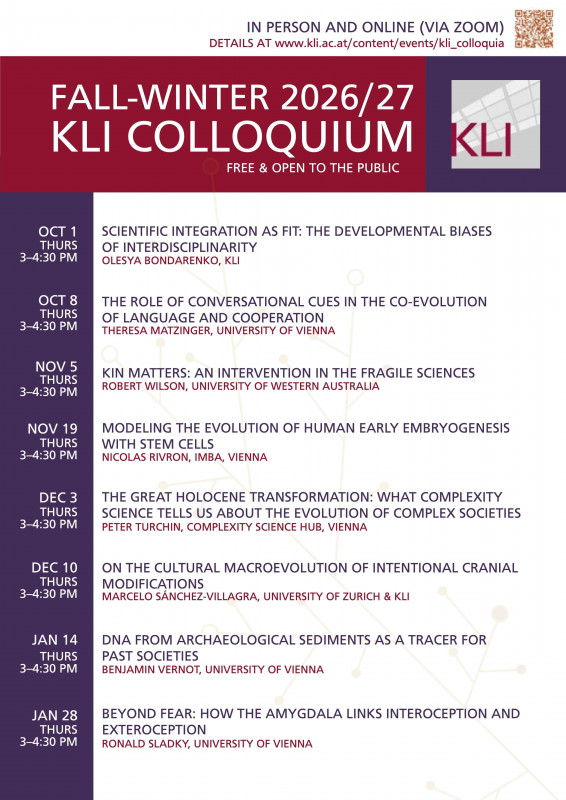
Scientific Integration as Fit: The Developmental Biases of Interdisciplinarity
Olesya BONDARENKO (KLI)
8 October 2026 (Thurs) 3-4:30 PM CET
The Role of Conversational Cues in the Co-Evolution of Language and Cooperation
Theresa MATZINGER (University of Vienna)
5 November 2026 (Thurs) 3-4:30 PM CET
Kin Matters: An Intervention in the Fragile Sciences
Robert A. WILSON (University of Western Australia)
19 November 2026 (Thurs) 3-4:30 PM CET
Modeling the Evolution of Human Early Embryogenesis with Stem Cells
Nicolas RIVRON (Institute of Molecular Biotechnology/IMBA, Vienna)
3 December 2026 (Thurs) 3-4:30 PM CET
Peter TURCHIN (Complexity Science Hub, Vienna)
10 December 2026 (Thurs) 3-4:30 PM CET
On the Cultural Macroevolution of Intentional Cranial Modifications
Marcelo SÁNCHEZ-VILLAGRA (University of Zurich)
14 January 2027 (Thurs) 3-4:30 PM CET
DNA from Archaeological Sediments as a Tracer for Past Societies
Benjamin VERNOT (University of Vienna)
28 January 2027 (Thurs) 3-4:30 PM CET
Beyond Fear: How the Amygdala Links Interoception and Exteroception
Ronald SLADKY (University of Vienna)
KLI Colloquia 2014 – 2026
Event Details

Title
STS Researchers as ‘Technology’: Leveraging Positionality to Understand Interdisciplinary Dynamics
Abstract
Science and technology studies (STS) researchers integrated in interdisciplinary research projects learn important lessons of collaboration dynamics by analysing the ‘lived experience’ of the research participants. Previous approaches of STS researchers included laboratory studies and reimagining the collaborative process as a research method. However, previous research on interdisciplinary projects repeatedly cite the same challenges, indicating that more sharing of this lived experience is needed. My research builds on previous STS ethnographies to conceptualise my role as an STS researcher into a producer of data and data collection tool, or a research ‘technology’. This account demonstrates how approaching my role in the collaboration as a ‘technology’ lead to understandings of power dynamics and what is understood as ‘good research’ across disciplines. These findings, revealed by the STS researcher as a producer of data, help us understand how individuals appraise interdisciplinarity, setting realistic expectations to address future interdisciplinary collaborations more deliberately.
Keywords: Interdisciplinary collaboration; reflexivity; research methodology; science and technology studies; autoethnography
