

KLI Colloquia are invited research talks of about an hour followed by 30 min discussion. The talks are held in English, open to the public, and offered in hybrid format.
Join via Zoom:
https://us02web.zoom.us/j/5881861923?omn=85945744831
Meeting ID: 588 186 1923
Fall-Winter 2026/27 KLI Colloquium Series
1 October 2026 (Thurs) 3-4:30 PM CET 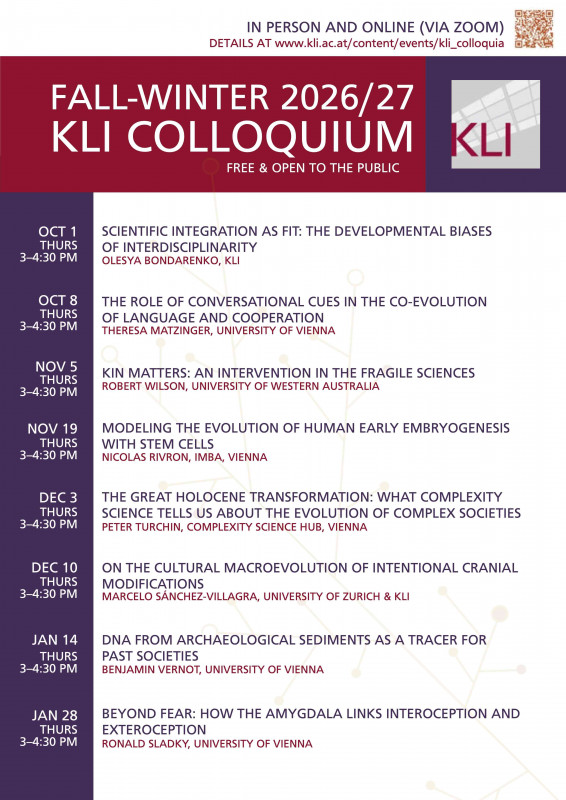
Scientific Integration as Fit: The Developmental Biases of Interdisciplinarity
Olesya BONDARENKO (KLI)
8 October 2026 (Thurs) 3-4:30 PM CET
The Role of Conversational Cues in the Co-Evolution of Language and Cooperation
Theresa MATZINGER (University of Vienna)
5 November 2026 (Thurs) 3-4:30 PM CET
Kin Matters: An Intervention in the Fragile Sciences
Robert A. WILSON (University of Western Australia)
19 November 2026 (Thurs) 3-4:30 PM CET
Modeling the Evolution of Human Early Embryogenesis with Stem Cells
Nicolas RIVRON (Institute of Molecular Biotechnology/IMBA, Vienna)
3 December 2026 (Thurs) 3-4:30 PM CET
Peter TURCHIN (Complexity Science Hub, Vienna)
10 December 2026 (Thurs) 3-4:30 PM CET
On the Cultural Macroevolution of Intentional Cranial Modifications
Marcelo SÁNCHEZ-VILLAGRA (University of Zurich)
14 January 2027 (Thurs) 3-4:30 PM CET
DNA from Archaeological Sediments as a Tracer for Past Societies
Benjamin VERNOT (University of Vienna)
28 January 2027 (Thurs) 3-4:30 PM CET
Beyond Fear: How the Amygdala Links Interoception and Exteroception
Ronald SLADKY (University of Vienna)
KLI Colloquia 2014 – 2026
Event Details
Abstract:
With adaptation to climate change becoming a dominant paradigm in international development, major river deltas have been at the forefront of efforts to steer development along a climate-resilient path. The Mekong Delta of Vietnam, for example, has become an international laboratory for climate adaptation governance, guided prominently by the Dutch-supported “Mekong Delta Plan” (2013) as well as funding from a recent World Bank “Integrated Climate Resilience and Sustainable Livelihoods” project. Within Vietnam, an entire multilevel governance apparatus is engaged in furthering the climate change adaptation agenda. A politics of translation is at the heart of these operations, as differently situated actors reproduce, negotiate, and mobilize adaptation knowledge in pursuit of varied objectives, seeking to move from conceptualization to implementation. This paper examines the role of intermediary actors that work as mediators in this process, translating knowledge upwards as well as down in the governance system. Drawing on multi-scalar ethnographic research with Vietnamese scientists, provincial-level bureaucrats, and agricultural extension agents, it considers the agency these actors have in shaping the trajectory of socio-ecological change in the Delta. By exploring strategies of translation and the intersections of different identities, interests, and agendas, the paper pinpoints contestations and switch-points that occur and seeks to identify potential openings for transformative pathways to emerge.
