

KLI Colloquia are invited research talks of about an hour followed by 30 min discussion. The talks are held in English, open to the public, and offered in hybrid format.
Join via Zoom:
https://us02web.zoom.us/j/5881861923?omn=85945744831
Meeting ID: 588 186 1923
Fall-Winter 2026/27 KLI Colloquium Series
1 October 2026 (Thurs) 3-4:30 PM CET 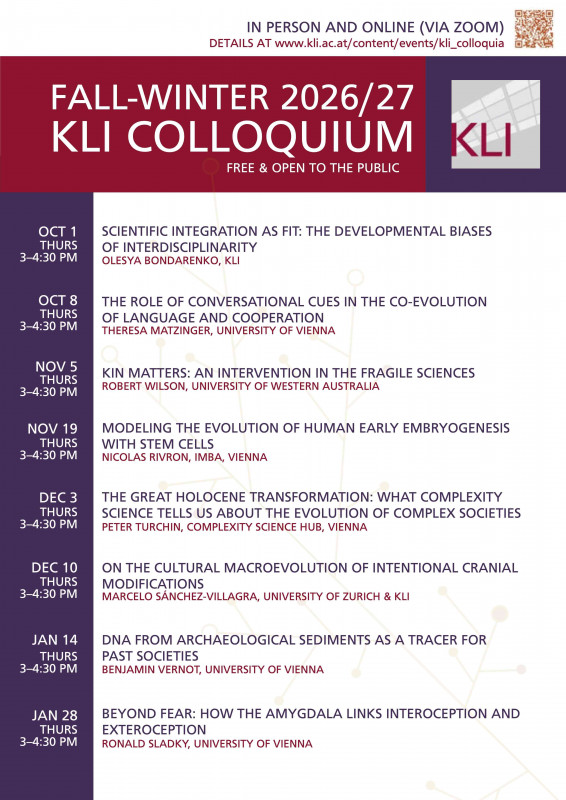
Scientific Integration as Fit: The Developmental Biases of Interdisciplinarity
Olesya BONDARENKO (KLI)
8 October 2026 (Thurs) 3-4:30 PM CET
The Role of Conversational Cues in the Co-Evolution of Language and Cooperation
Theresa MATZINGER (University of Vienna)
5 November 2026 (Thurs) 3-4:30 PM CET
Kin Matters: An Intervention in the Fragile Sciences
Robert A. WILSON (University of Western Australia)
19 November 2026 (Thurs) 3-4:30 PM CET
Modeling the Evolution of Human Early Embryogenesis with Stem Cells
Nicolas RIVRON (Institute of Molecular Biotechnology/IMBA, Vienna)
3 December 2026 (Thurs) 3-4:30 PM CET
Peter TURCHIN (Complexity Science Hub, Vienna)
10 December 2026 (Thurs) 3-4:30 PM CET
On the Cultural Macroevolution of Intentional Cranial Modifications
Marcelo SÁNCHEZ-VILLAGRA (University of Zurich)
14 January 2027 (Thurs) 3-4:30 PM CET
DNA from Archaeological Sediments as a Tracer for Past Societies
Benjamin VERNOT (University of Vienna)
28 January 2027 (Thurs) 3-4:30 PM CET
Beyond Fear: How the Amygdala Links Interoception and Exteroception
Ronald SLADKY (University of Vienna)
KLI Colloquia 2014 – 2026
Event Details
Topic description / abstract:
Evolutionary biology is famously undergoing philosophical discussions over the alleged need to extend, or even reconsider, some of its theoretical bases. Within this debate, evo-devo has raised as one salient field from which the classical understanding of evolution can be challenged, its main contribution being that the developmental bases of phenotypes have a profound impact on the course of evolution that was overlooked in the classical framework. While the philosophy of evo-devo is a growing area, many of the conceptual challenges that this interdisciplinary field poses for evolutionary thinking remain understudied. In this talk, I address one significant aspect of evo-devo that has yet not been sufficiently considered in philosophical analyses: its potential integration in probabilistic models of evolution. In particular, by taking a propensity understanding of some developmentally-based variational tendencies (such as modularity or evolvability), I intend to build a bridge between the classical, probabilistic means of modeling evolutionary change, and the evo-devo view of seeing development as a cause of evolution. In doing so, I propose a way in which developmental propensities can be seen as ultimate causes in the sense introduced by Mayr.
Biographical note:
