

KLI Colloquia are invited research talks of about an hour followed by 30 min discussion. The talks are held in English, open to the public, and offered in hybrid format.
Join via Zoom:
https://us02web.zoom.us/j/5881861923?omn=85945744831
Meeting ID: 588 186 1923
Fall-Winter 2026/27 KLI Colloquium Series
1 October 2026 (Thurs) 3-4:30 PM CET 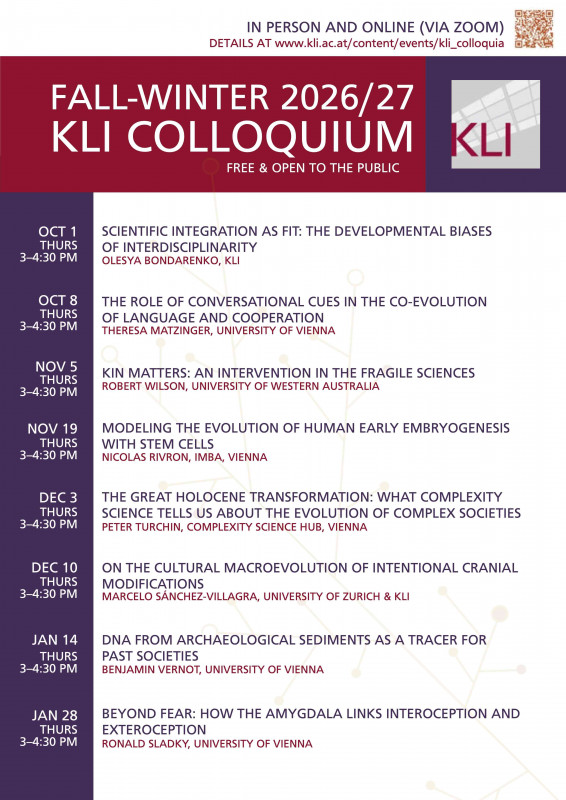
Scientific Integration as Fit: The Developmental Biases of Interdisciplinarity
Olesya BONDARENKO (KLI)
8 October 2026 (Thurs) 3-4:30 PM CET
The Role of Conversational Cues in the Co-Evolution of Language and Cooperation
Theresa MATZINGER (University of Vienna)
5 November 2026 (Thurs) 3-4:30 PM CET
Kin Matters: An Intervention in the Fragile Sciences
Robert A. WILSON (University of Western Australia)
19 November 2026 (Thurs) 3-4:30 PM CET
Modeling the Evolution of Human Early Embryogenesis with Stem Cells
Nicolas RIVRON (Institute of Molecular Biotechnology/IMBA, Vienna)
3 December 2026 (Thurs) 3-4:30 PM CET
Peter TURCHIN (Complexity Science Hub, Vienna)
10 December 2026 (Thurs) 3-4:30 PM CET
On the Cultural Macroevolution of Intentional Cranial Modifications
Marcelo SÁNCHEZ-VILLAGRA (University of Zurich)
14 January 2027 (Thurs) 3-4:30 PM CET
DNA from Archaeological Sediments as a Tracer for Past Societies
Benjamin VERNOT (University of Vienna)
28 January 2027 (Thurs) 3-4:30 PM CET
Beyond Fear: How the Amygdala Links Interoception and Exteroception
Ronald SLADKY (University of Vienna)
KLI Colloquia 2014 – 2026
Event Details
You are invited to a Zoom meeting.
When: Jan 25, 2024 03:00 PM Vienna
Register in advance for this meeting:
https://us02web.zoom.us/meeting/register/tZYrcu6uqzgjG9wfGQbofUAMp4yHeb2rlk_a
After registering, you will receive a confirmation email containing information about joining the meeting.
Topic description / abstract:
Climate change and biocultural diversity loss are some of the defining challenges of the Anthropocene. They have resulted in part from dominant Cartesian modes of thinking which separate mind and matter, object and subject, and social and ecological systems. Such thinking is likely to fall short of delivering the transformative solutions needed to address these challenges, as it fails to recognize the co-dependencies that fundamentally shape how we interact with, and are part of, the natural world. In the past five years there has been a shift in sustainability science to recognize the importance of relational philosophies – anchored in a recognition of these co-dependencies. However, there remains a gap in translating this recognition and ‘knowing’, into ‘doing’ science differently, in a way that recognizes how the process of science itself is also a process of ‘co-becoming’ between the researcher and the world of which we are. In this talk I present recent work in the conceptualization and theorization of the resilience of social-ecological systems as a way to understand capacity to change, by drawing on theories of co-evolution, structuration (agency) and new materialism. The talk draws on a collaborative ethnography from an Austrian Mountain farm, in which I explore how representational capacities for resilience can shift to performative capacities that enable a shift from ‘knowing’ and ‘doing’ to ‘becoming’ differently.
Biographical note:
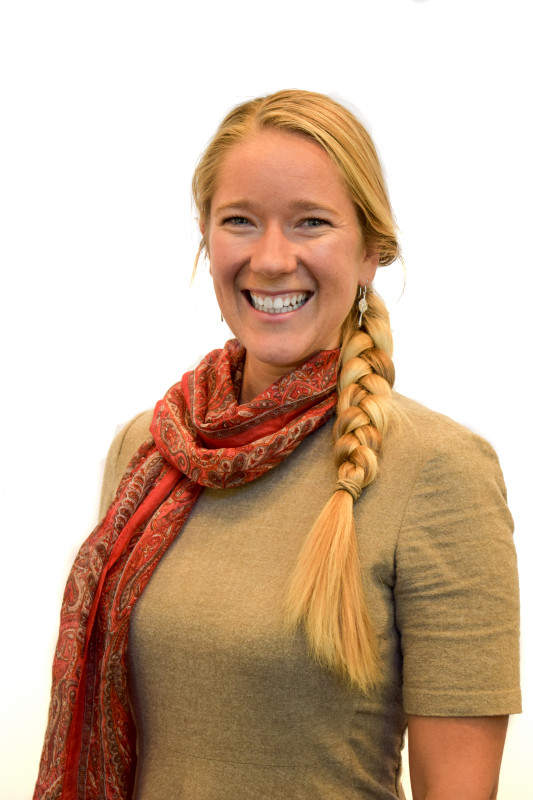
Dr. Jamila Haider is a Researcher at Stockholm Resilience Centre, where she co-leads the Resilience and Sustainable Development Research Theme. She studies the relationships between cultural and biological diversity through the lens of food. Research interests are centred in a) the maintenance of cultural and ecological diversity in mountains, b) the meaning and application of resilience as the capacity to change, and c) how researchers can engage more reflexively in the process of science, both to be more aware of deep interdependencies between science, scientists and practice, and to foster more caring ways of doing science. Dr. Haider has worked as a development practitioner in Central Asia and Afghanistan. She is author of 50+ peer reviewed articles, an award-winning book, and is currently working on a non-fiction book together with an Austrian mountain farmer, exploring sufficiency at the heart of sustainability and what it means to become truly alive in the face of uncertainty.
