

KLI Colloquia are invited research talks of about an hour followed by 30 min discussion. The talks are held in English, open to the public, and offered in hybrid format.
Join via Zoom:
https://us02web.zoom.us/j/5881861923?omn=85945744831
Meeting ID: 588 186 1923
Fall-Winter 2026/27 KLI Colloquium Series
1 October 2026 (Thurs) 3-4:30 PM CET 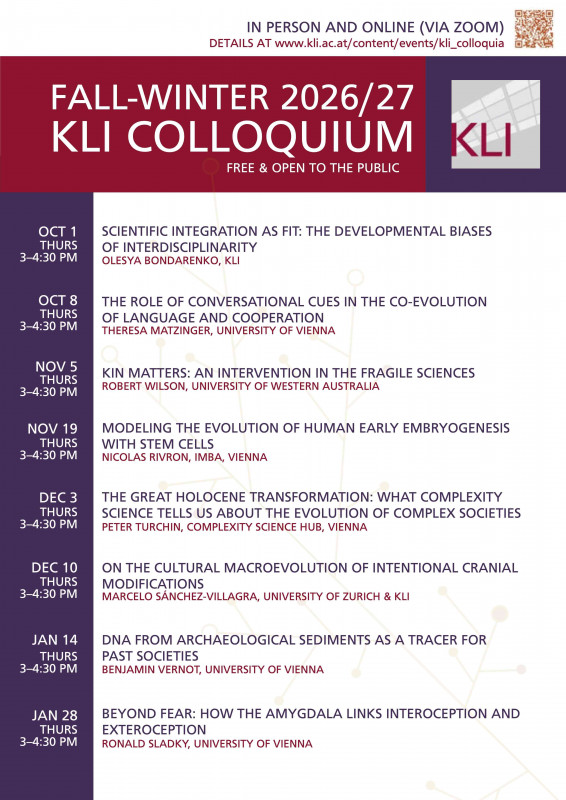
Scientific Integration as Fit: The Developmental Biases of Interdisciplinarity
Olesya BONDARENKO (KLI)
8 October 2026 (Thurs) 3-4:30 PM CET
The Role of Conversational Cues in the Co-Evolution of Language and Cooperation
Theresa MATZINGER (University of Vienna)
5 November 2026 (Thurs) 3-4:30 PM CET
Kin Matters: An Intervention in the Fragile Sciences
Robert A. WILSON (University of Western Australia)
19 November 2026 (Thurs) 3-4:30 PM CET
Modeling the Evolution of Human Early Embryogenesis with Stem Cells
Nicolas RIVRON (Institute of Molecular Biotechnology/IMBA, Vienna)
3 December 2026 (Thurs) 3-4:30 PM CET
Peter TURCHIN (Complexity Science Hub, Vienna)
10 December 2026 (Thurs) 3-4:30 PM CET
On the Cultural Macroevolution of Intentional Cranial Modifications
Marcelo SÁNCHEZ-VILLAGRA (University of Zurich)
14 January 2027 (Thurs) 3-4:30 PM CET
DNA from Archaeological Sediments as a Tracer for Past Societies
Benjamin VERNOT (University of Vienna)
28 January 2027 (Thurs) 3-4:30 PM CET
Beyond Fear: How the Amygdala Links Interoception and Exteroception
Ronald SLADKY (University of Vienna)
KLI Colloquia 2014 – 2026
Event Details

To join the KLI Colloquia via Zoom:Join Zoom Meeting
https://us02web.zoom.us/j/5881861923?omn=85945744831
Meeting ID: 588 186 1923
Topic description / abstract
What is the relationship between the development and evolution of human bipedalism? From fetal swimming movement in the amniotic fluid to quadrupedal crawling after birth and the eventual acquisition of upright bipedal walking, ontogeny appears to recapitulate phylogeny. However, through our MRI-based observations and analysis of human fetal movement, we discovered that the coordination between the trunk posture and lower limb movements necessary for upright bipedal walking is spontaneously generated during fetal periods. This suggests that a precursor to bipedalism emerges during fetal development, is preserved after birth rather than being lost, and through a delay in the development of locomotion, ultimately leads to the acquisition of a unique mode of locomotion on the ground. Such a neotenic development implies that only humans evolved habitual bipedalism through heterochronic regulation of the fetal trait of our ancestors. Thus, understanding the early development of the neural mechanisms involved contributes to the construction of an Evo-Devo theory that provides a comprehensive understanding of the development and evolution of bipedalism.
Biographical note:
Gentaro Taga is a professor at Graduate School of Education, The University of Tokyo. He is known for proposing a neuro-musculo-skeletal model that self-organizes human bipedal locomotion. He founded the Developmental Neuroscience Laboratory, which is recognized for being the first to apply near-infrared spectroscopy for brain function imaging in infants. His research has clarified the early development of infants' perception, movements, cognition, language, memory, and the brain development involved in these functions. In recent years, his work has focused on topics such as the emergence of self-agency, speech production, sleep, cortical network, brain blood flow, metabolism, and water circulation, and gut microbiota. Additionally, he is involved in collaborative research on brain and behavioral development in preterm infants and fetuses, and has expanded his interest into evolutionary issues.
Gentaro Taga received the Ph. D. degree in pharmaceutical sciences (biophysics) from University of Tokyo in 1994 under the supervision of Prof. Hiroshi Shimizu. He was a JSPS postdoctoral fellow of at Yukawa Institute for Theoretical Physics, Kyoto University and Neuro-Muscular Research Center, Boston University in 1994. He joined the complex system research group of Prof. Kunihiko Kaneko as an assistant professor at Department of Pure and Applied sciences, University of Tokyo in 1995. He was jointly appointed as a HFSP short term fellow to study infant perception at psychophysics laboratory of Prof. Shinsuke Shimojo at California Institute of Technology in 1998. In 2000 Gentaro Taga established Developmental Brain Science Laboratory at Graduate School of Education, The University of Tokyo. He was a visiting scholar at Biomedical Optics Research Laboratory, Clinic of Neonatology, University Hospital Zurich in 2017. He was a visiting fellow at KLI in 2018, and since then he has frequently visited Vienna for collaborating studies at Vienna Medical University.
