

KLI Colloquia are invited research talks of about an hour followed by 30 min discussion. The talks are held in English, open to the public, and offered in hybrid format.
Join via Zoom:
https://us02web.zoom.us/j/5881861923?omn=85945744831
Meeting ID: 588 186 1923
Fall-Winter 2026/27 KLI Colloquium Series
1 October 2026 (Thurs) 3-4:30 PM CET 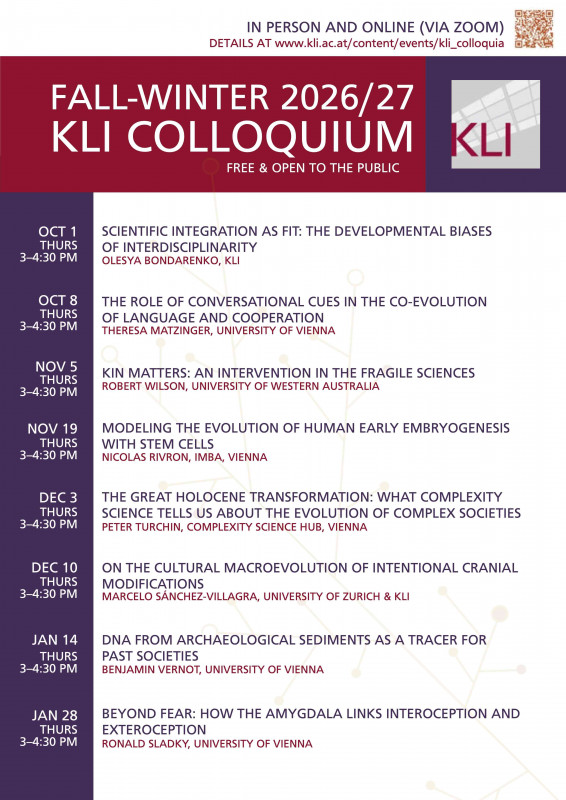
Scientific Integration as Fit: The Developmental Biases of Interdisciplinarity
Olesya BONDARENKO (KLI)
8 October 2026 (Thurs) 3-4:30 PM CET
The Role of Conversational Cues in the Co-Evolution of Language and Cooperation
Theresa MATZINGER (University of Vienna)
5 November 2026 (Thurs) 3-4:30 PM CET
Kin Matters: An Intervention in the Fragile Sciences
Robert A. WILSON (University of Western Australia)
19 November 2026 (Thurs) 3-4:30 PM CET
Modeling the Evolution of Human Early Embryogenesis with Stem Cells
Nicolas RIVRON (Institute of Molecular Biotechnology/IMBA, Vienna)
3 December 2026 (Thurs) 3-4:30 PM CET
Peter TURCHIN (Complexity Science Hub, Vienna)
10 December 2026 (Thurs) 3-4:30 PM CET
On the Cultural Macroevolution of Intentional Cranial Modifications
Marcelo SÁNCHEZ-VILLAGRA (University of Zurich)
14 January 2027 (Thurs) 3-4:30 PM CET
DNA from Archaeological Sediments as a Tracer for Past Societies
Benjamin VERNOT (University of Vienna)
28 January 2027 (Thurs) 3-4:30 PM CET
Beyond Fear: How the Amygdala Links Interoception and Exteroception
Ronald SLADKY (University of Vienna)
KLI Colloquia 2014 – 2026
Event Details

Join Zoom Meeting
https://us02web.zoom.us/j/5881861923?omn=85945744831
Meeting ID: 588 186 1923
Topic description / abstract:
Music and language (M&L), our species' most distinctive modes of expression and communication, share an intricate relationship, the granular details of which remain fiercely debated. Both domains combine discrete elements into mental hierarchical structures, shaping phrase and phonological structures in language, and defining tonality and metre in music. Meanwhile, interdisciplinary research in life sciences has sought to unify evolution, cognition, and animal communication. Frameworks like active inference and biosemiotics, grounded in information theory, have been used to model niche construction and communication in both biological organisms and computational agents. Similarly, evolutionary theorists emphasise dynamical-systems behaviours in shaping evolutionary processes. Together, these perspectives offer potential tools for modelling the evolutionary origins of M&L, particularly in relation to building blocks shared with animal communication. While identifying precursors of human capacities in other species remains important, a crucial next step is understanding how traits interacted over evolutionary time to give rise to M&L as we know them. That is, analytical decomposition must be complemented by the reconstruction of evolutionary pathways.
This talk presents two independent but complementary agendas of ongoing research, addressing the M-L relationship as individual cognition and as population-level emergence. The first investigates syntactic granularity, focusing on predictive neural mechanisms for M&L syntax beyond domain-specific modularity. Using mainly fMRI and brain stimulation, we longitudinally track neuroplasticity within brain networks supporting harmonic, but possibly also phrasal and phonological structure-building. Taking a step back, the second agenda explores the hypothesis that human vocalisations specialised into distinct cultural lineages—song and speech—through differentiation dynamics akin to biological speciation kindling, at the population level, iterative cycles of constraints and affordances ("cultural epicycles", Wagner & Tomlinson, 2022). We draft a first attempt to adapt Jaeger et al.'s (2015, 2021) evolutionary-systems-biology framework—proposing that differential gene expression dynamics, rather than static gene network structures, drive morphological differentiation—to the domain of culture and cognition. Aligning with predictive-brain views, we propose that diverging predictive dynamics in vocal interactions mediate between cognitive functions (e.g., social coordination) and cultural phenotypes (e.g., song and speech acoustics). By operationalising predictability in information-theoretic terms, and treating core traits of musicality and language as parameters, we outline a configuration space that could help reconstruct the evolutionary pathways of M&L.
Biographical note:
With a background in Engineering (Bucharest) and Experimental Psychology (Oxford), Tudor Popescu approaches music as a bio-socio-cultural phenomenon. He is particularly interested in the cognition of harmonic structures, and in the cultural evolution of tonality. Having recently moved back to Vienna, he is currently a PI in UniWien's Faculty of Psychology, working on an FWF project exploring neurocognitive parallels between language and music.
