

KLI Colloquia are invited research talks of about an hour followed by 30 min discussion. The talks are held in English, open to the public, and offered in hybrid format.
Join via Zoom:
https://us02web.zoom.us/j/5881861923?omn=85945744831
Meeting ID: 588 186 1923
Fall-Winter 2026/27 KLI Colloquium Series
1 October 2026 (Thurs) 3-4:30 PM CET 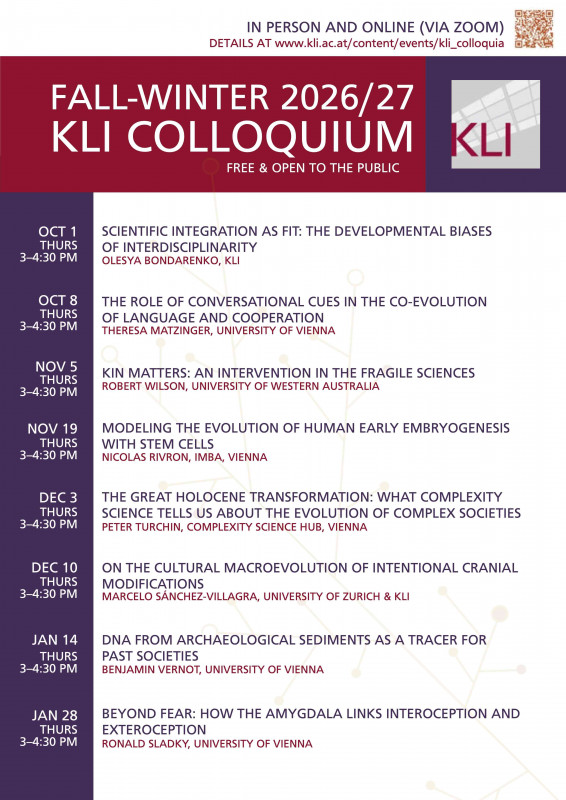
Scientific Integration as Fit: The Developmental Biases of Interdisciplinarity
Olesya BONDARENKO (KLI)
8 October 2026 (Thurs) 3-4:30 PM CET
The Role of Conversational Cues in the Co-Evolution of Language and Cooperation
Theresa MATZINGER (University of Vienna)
5 November 2026 (Thurs) 3-4:30 PM CET
Kin Matters: An Intervention in the Fragile Sciences
Robert A. WILSON (University of Western Australia)
19 November 2026 (Thurs) 3-4:30 PM CET
Modeling the Evolution of Human Early Embryogenesis with Stem Cells
Nicolas RIVRON (Institute of Molecular Biotechnology/IMBA, Vienna)
3 December 2026 (Thurs) 3-4:30 PM CET
Peter TURCHIN (Complexity Science Hub, Vienna)
10 December 2026 (Thurs) 3-4:30 PM CET
On the Cultural Macroevolution of Intentional Cranial Modifications
Marcelo SÁNCHEZ-VILLAGRA (University of Zurich)
14 January 2027 (Thurs) 3-4:30 PM CET
DNA from Archaeological Sediments as a Tracer for Past Societies
Benjamin VERNOT (University of Vienna)
28 January 2027 (Thurs) 3-4:30 PM CET
Beyond Fear: How the Amygdala Links Interoception and Exteroception
Ronald SLADKY (University of Vienna)
KLI Colloquia 2014 – 2026
Event Details

Join Zoom Meeting
https://us02web.zoom.us/j/5881861923?omn=85945744831
Meeting ID: 588 186 1923
Topic description / abstract:
When we study genotype-phenotype maps, we are mostly focusing on the relationship between genetic variation and the average trait value per genotype. However, there is mounting evidence that phenotypic variance can be understood as a trait on its own, with potentially independent genetic regulation and evolutionary trajectories, when compared to the mean trait value. In this talk, we will focus on Drosophila melanogaster populations exposed to different dietary conditions, and discuss to which extent phenotypic variance in response to environmental changes (i.e., phenotypic robustness) is genetically regulated, whether it propagates across different layers of the G-P map, and under which conditions it could evolve.
Biographical note:
Luisa Pallares was born in Ocaña, a city in the north east of Colombia, and got her Bachelors degree in Biology from the Universidad Nacional de Colombia in Bogotá. Then, with a fellowship from the Max-Planck Research School for Evolutionary Biology (IMPRS), she moved to Plön, Germany, where she did her PhD at the Max-Planck Institute for Evolutionary Biology and the Christian-Albrechts-Universität zu Kiel, under the supervision of Diethard Tautz. Later on, with a Long-Term Postdoctoral Fellowship from the Human Frontiers Science Program (HFSP) she moved to Princeton University in the US where she was a postdoctoral fellow in the Ayroles Lab affiliated to the Ecology and Evolutionary Biology Department and the Lewis-Sigler Institute for Integrative Genomics.
Since February 2022, she leads the Max Planck Research Group on “Evolutionary Genomics of Complex Traits.” Her research group is located in the Friedrich Miescher Laboratory of the Max Planck Society (FML) and the Max Planck Institute for Biology in Tübingen (Germany).
