

News Details
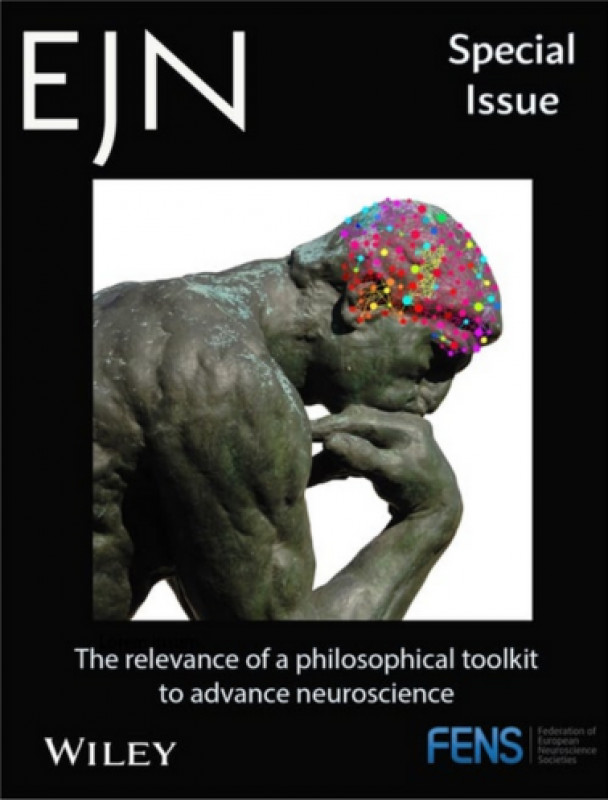
KLI Executive Manager and Group Leader Isabella Sarto-Jackson, together with Markus Kunze (Medical University of Vienna), Ann Sophie-Barwich (University of Indiana, Bloomington), and Igor Branchi (Italian Institute of Health, Rome), edited a Special Issue on “The Relevance of a Philosophical Toolkit to Advance Neuroscience” in the European Journal of Neuroscience.
Their Editorial for the Special Issue introduces the comprehensive, interdisciplinary collection of 31 papers that lays the foundation for collaborative efforts between neuroscientists and philosophers to address complex issues related to brain function in normal and diseased states. In their contributions, the different authors demonstrate how philosophical tools can address challenges such as reductionism, causal reasoning, model building, and conceptual precision across neuroscience. More specifically, neuroscience can be strengthened by systematically incorporating philosophical methods to clarify concepts, examine assumptions, and improve the interpretation of increasingly complex data and models. Thus, sustained collaboration between philosophers and neuroscientists can foster more rigorous, integrative, and theoretically grounded research, ultimately advancing our understanding of the brain and mind.
The issue additionally features an article, co-authored by Isabella, on "How to Foster Challenging Interdisciplinary Collaborations: Can Philosophy Support Neuroscientists?” The authors argue that neuroscience frequently considers the identification of neural mechanisms as sufficient for explaining behavior. However, this reductionist approach overlooks other important forms of causation, including historical, developmental, and environmental influences. The paper proposes a broader framework for causal explanation that incorporates top-down, multilevel, and temporally extended causes, showing how philosophical analyses of causation can complement mechanistic neuroscience. The authors contend that expanding neuroscience's causal toolkit will lead to richer, more accurate explanations of brain function and behavior and improve both basic and translational research.
Publications:
Kunze, M., Barwich, A.-S., Branchi, I. and Sarto-Jackson, I. (2026) The Relevance of a Philosophical Toolkit to Advance Neuroscience. Eur J Neurosci, 64: e70594. https://doi.org/10.1111/ejn.70594
Kunze, M., C. Brun, J. Badaut, M. Darnaudéry, F. Gross, L. Peltier, T. Pradeu, I. Sarto-Jackson, J.P. Konsman (2026) How to Foster Challenging Interdisciplinary Collaborations: Can Philosophy Support Neuroscientists? Eur J Neurosci, 63, no. 11: e70542. https://doi.org/10.1111/ejn.70542.