

KLI Colloquia are invited research talks of about an hour followed by 30 min discussion. The talks are held in English, open to the public, and offered in hybrid format.
Join via Zoom:
https://us02web.zoom.us/j/5881861923?omn=85945744831
Meeting ID: 588 186 1923
Fall-Winter 2026/27 KLI Colloquium Series
1 October 2026 (Thurs) 3-4:30 PM CET 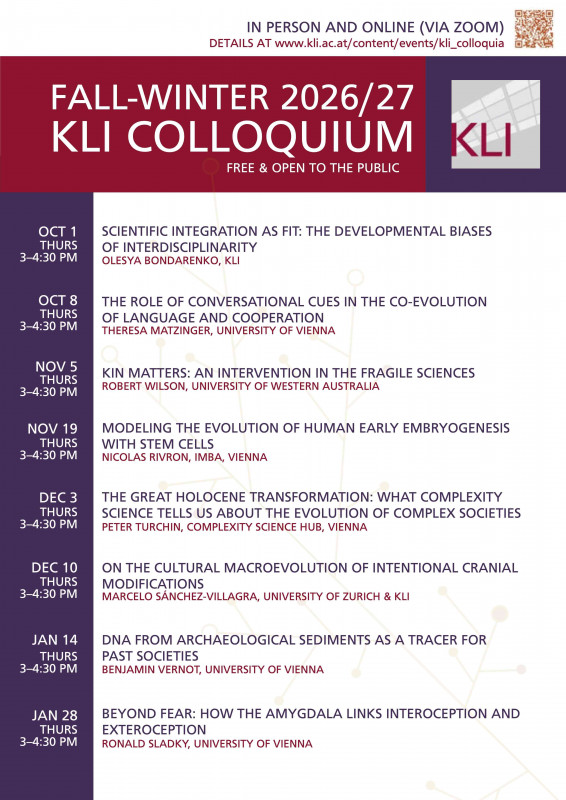
Scientific Integration as Fit: The Developmental Biases of Interdisciplinarity
Olesya BONDARENKO (KLI)
8 October 2026 (Thurs) 3-4:30 PM CET
The Role of Conversational Cues in the Co-Evolution of Language and Cooperation
Theresa MATZINGER (University of Vienna)
5 November 2026 (Thurs) 3-4:30 PM CET
Kin Matters: An Intervention in the Fragile Sciences
Robert A. WILSON (University of Western Australia)
19 November 2026 (Thurs) 3-4:30 PM CET
Modeling the Evolution of Human Early Embryogenesis with Stem Cells
Nicolas RIVRON (Institute of Molecular Biotechnology/IMBA, Vienna)
3 December 2026 (Thurs) 3-4:30 PM CET
Peter TURCHIN (Complexity Science Hub, Vienna)
10 December 2026 (Thurs) 3-4:30 PM CET
On the Cultural Macroevolution of Intentional Cranial Modifications
Marcelo SÁNCHEZ-VILLAGRA (University of Zurich)
14 January 2027 (Thurs) 3-4:30 PM CET
DNA from Archaeological Sediments as a Tracer for Past Societies
Benjamin VERNOT (University of Vienna)
28 January 2027 (Thurs) 3-4:30 PM CET
Beyond Fear: How the Amygdala Links Interoception and Exteroception
Ronald SLADKY (University of Vienna)
KLI Colloquia 2014 – 2026
Event Details

Picture Gallery
Theoretical biology emerged as a discourse among biologists from a variety of different experimental disciplines and some philosophers and physicians during the early decades of the 20th century. This discourse was centered around the conceptual, epistemological, and methodological foundations of biology as well as the relation of biology to physics and metaphysics (the problem of the autonomy of biology), mathematical modeling of biological processes (such as regulation, differentiation, inheritance, and organic transformation), and the representation of biological knowledge. It engaged many of the foremost biologists of Europe (Germany, The Netherlands, Austria, Russia, and Britain) and, to a lesser extent, the United States. Vienna has traditionally been a fertile ground for discussions related to theoretical biology. Several prominent members of the Vienna Medical School, arguably one of the leading centers of Medicine at the turn of the 20th century, had a strong interest in conceptual problems of biology and medicine; research in experimental and theoretical physics explored problems related to biology; Ernst Mach’s approach to history and philosophy of science was based on an evolutionary (or adaptationist) approach to knowledge. Last but not least, the Vivarium, an initially private Institute for Experimental Biology fostered research into the theoretically relevant problems relating physiology,development and environmental modification. On the year of the 100th anniversary of the foundation of the Vivarium the workshop will explore the historical roots as well as the legacy of theoretical biology in Vienna. It will focus on the history of the Vivarium and investigate the careers and contributions of important figures associated with it (Przibram, Kammerer, Exner, Weiss, von Bertalanffy). But the workshop is also intended to raise larger themes and open up fresh perspectives for theoretical biology in the 21st century. There will be papers that place the Viennese tradition in the larger context of modeling biological processes, explore the history and future perspective of research into the role of the environment in development, and analyze the significance of extra-university settings and research institutes in both the past and present. Finally, today´s role of theoretical biology in integrating the life sciences will be analyzed.
