

KLI Colloquia are invited research talks of about an hour followed by 30 min discussion. The talks are held in English, open to the public, and offered in hybrid format.
Join via Zoom:
https://us02web.zoom.us/j/5881861923?omn=85945744831
Meeting ID: 588 186 1923
Fall-Winter 2026/27 KLI Colloquium Series
1 October 2026 (Thurs) 3-4:30 PM CET 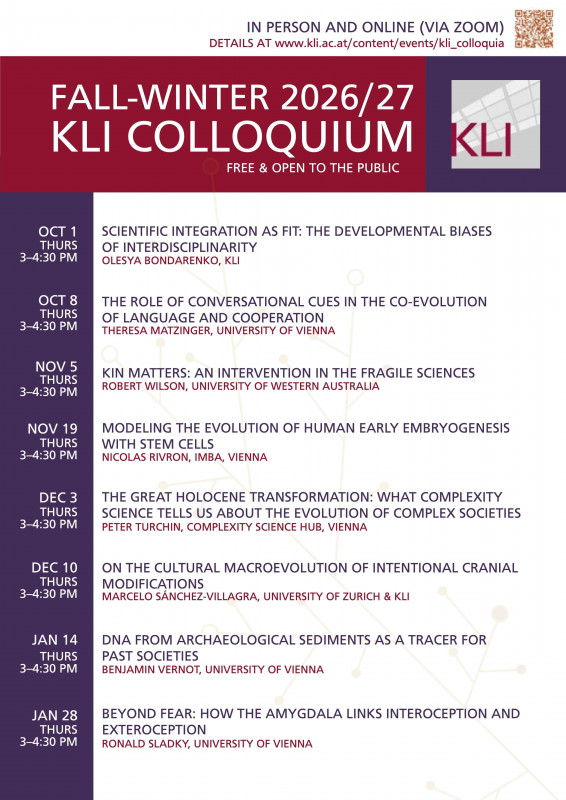
Scientific Integration as Fit: The Developmental Biases of Interdisciplinarity
Olesya BONDARENKO (KLI)
8 October 2026 (Thurs) 3-4:30 PM CET
The Role of Conversational Cues in the Co-Evolution of Language and Cooperation
Theresa MATZINGER (University of Vienna)
5 November 2026 (Thurs) 3-4:30 PM CET
Kin Matters: An Intervention in the Fragile Sciences
Robert A. WILSON (University of Western Australia)
19 November 2026 (Thurs) 3-4:30 PM CET
Modeling the Evolution of Human Early Embryogenesis with Stem Cells
Nicolas RIVRON (Institute of Molecular Biotechnology/IMBA, Vienna)
3 December 2026 (Thurs) 3-4:30 PM CET
Peter TURCHIN (Complexity Science Hub, Vienna)
10 December 2026 (Thurs) 3-4:30 PM CET
On the Cultural Macroevolution of Intentional Cranial Modifications
Marcelo SÁNCHEZ-VILLAGRA (University of Zurich)
14 January 2027 (Thurs) 3-4:30 PM CET
DNA from Archaeological Sediments as a Tracer for Past Societies
Benjamin VERNOT (University of Vienna)
28 January 2027 (Thurs) 3-4:30 PM CET
Beyond Fear: How the Amygdala Links Interoception and Exteroception
Ronald SLADKY (University of Vienna)
KLI Colloquia 2014 – 2026
Event Details

Picture Gallery
Rupert Riedl (Konrad Lorenz Institute) Welcome Address Fritz Stadler (Universität Wien) Mach, Boltzmann, and the Vienna Circle: Naturalism in the Context of Logical Empiricism Steve Fuller (University of Durham) What Can the Conflict Between Positivism and Pragmatism Teach Us About the Contemporary Viability of Evolutionary Naturalism? I: Evolutionary Epistemology Unified "From the Amoeba to Einstein": Philosophy as Continuous with Science Werner Callebaut (Konrad Lorenz Institute) and Karola Stotz (Konrad Lorenz Institute) Keynote address; Evolutionary Naturalism and the Challenge of Cognitive Development and Sociality Ronald N. Giere (University of Minnesota) Methodological Naturalism II: Evolutionary Naturalism: A Plausible Candidate for an Integral Epistemology? Massimo Stanzione (Università di Salerno) Open Questions in Evolutionary Epistemology: Reduction and/or Supervenience Robert J. Richards (University of Chicago) Darwin's Romantic Biology Linnda R. Caporael (Rensselaer Polytechnic Institute) Expanding the Functional Unit III: The Konrad Lorenz Legacy Robert J. Richards (University of Chicago) The Foundations of Konrad Lornez's Evolutionary Theory of Behavior Rupert Riedl (Konrad Lorenz Institute) Personal Reminiscences of Konrad Lorenz IV: Developmental Perspectives on Evolution Robert J. Richards (University of Chicago) Darwin's Use of von Baer for Recapitulation Theory Gerd B. Müller (University of Vienna & Konrad Lorenz Institute) Evolutionary Structuralism and the Concept of Burden Robert C. Richardson (University of Cincinnati) Generative Entrenchment and the Developmental Lock Model Paul E. Griffiths (University of Otago) Biology without Boundaries: Beyond Interactio nand Constraint V: Social Conditions of Cognition Linnda R. Caporael (Rensselaer Polytechnic Institute) The Descent of Knowledge Ludwig Huber (University of Vienna) At the Core of Evolutionary Epistemology: Animal Learning and the Evolution of Cognition Hans G. Furth (Catholic University of America) The Societal and Libidinam Nature of Object (=Mental) Knowledge in Human Development VI: Comprehensive Evolutionary Naturalism Ludwig Grillich (Konrad Lorenz Institute) The View from Psychology Werner Callebaut (Konrad Lorenz Institute) The View from Philosophy W. D. Christensen and C. A. Hooker (University of New South Wales) The Organization of Knowledge: An Autonomy-Theoretic Critique of Evolutionary Epistemology William C. Wimsatt (University of Chicago) Generative Entrenchment and the Evolution of Complexity in Scientific Systems James R. Griesemer (University of California, Davis) False (Evolutionary) Models as Means to a Robust Synthesis
