

KLI Colloquia are invited research talks of about an hour followed by 30 min discussion. The talks are held in English, open to the public, and offered in hybrid format.
Join via Zoom:
https://us02web.zoom.us/j/5881861923?omn=85945744831
Meeting ID: 588 186 1923
Fall-Winter 2026/27 KLI Colloquium Series
1 October 2026 (Thurs) 3-4:30 PM CET 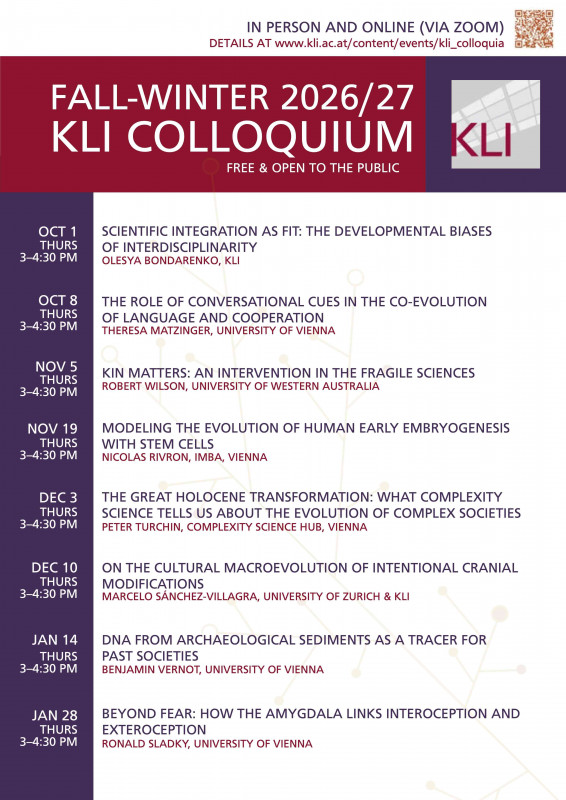
Scientific Integration as Fit: The Developmental Biases of Interdisciplinarity
Olesya BONDARENKO (KLI)
8 October 2026 (Thurs) 3-4:30 PM CET
The Role of Conversational Cues in the Co-Evolution of Language and Cooperation
Theresa MATZINGER (University of Vienna)
5 November 2026 (Thurs) 3-4:30 PM CET
Kin Matters: An Intervention in the Fragile Sciences
Robert A. WILSON (University of Western Australia)
19 November 2026 (Thurs) 3-4:30 PM CET
Modeling the Evolution of Human Early Embryogenesis with Stem Cells
Nicolas RIVRON (Institute of Molecular Biotechnology/IMBA, Vienna)
3 December 2026 (Thurs) 3-4:30 PM CET
Peter TURCHIN (Complexity Science Hub, Vienna)
10 December 2026 (Thurs) 3-4:30 PM CET
On the Cultural Macroevolution of Intentional Cranial Modifications
Marcelo SÁNCHEZ-VILLAGRA (University of Zurich)
14 January 2027 (Thurs) 3-4:30 PM CET
DNA from Archaeological Sediments as a Tracer for Past Societies
Benjamin VERNOT (University of Vienna)
28 January 2027 (Thurs) 3-4:30 PM CET
Beyond Fear: How the Amygdala Links Interoception and Exteroception
Ronald SLADKY (University of Vienna)
KLI Colloquia 2014 – 2026
Event Details

Topic description:
For the last two hundred years, the developmental series has served as the main means of visual representation in embryology. The typical developmental series consists of a sequence of images each depicting a different stage in the genesis of the embryo. Over the last two decades, novel techniques of imaging have been introduced. Techniques such as the “in toto” representation or “multiview in vivo imaging” of the embryogenesis of an organism aim at tracing every single cell, from every angle, in every moment throughout the entire course of development. The ultimate aim is a predictive computational model of embryogenesis.
In my paper, I will discuss the impact of new techniques of imaging and computing embryogenesis on the biological notion of development. In particular, I will ask what the claim of a) conceiving of the totality of embryogenesis and b) of its ‘in vivo’ representation entail and will argue that the new imaging techniques shift the border between where the representation of life begins and its reality ends. As I will show, this not only has consequences for the concept of time at the heart of the notion of development, but also of the living as put forward in current developmental biology.
Biographical note:
Janina Wellmann graduated from Humboldt University Berlin and holds a joint PhD in history of science from the Technical University Berlin and the Ecole de Hautes Etudes en Sciences Sociales Paris. She stayed as a post-doctoral fellow at the Max Planck Institute for the History of Science, the Cohn Institute for the History and Philosophy of Science and Ideas at Tel Aviv University and spent the year 2013/14 as a fellow at the Wissenschaftskolleg zu Berlin. Her work focuses on the history and epistemology of the life sciences in the modern era. She is the author of The Form of Becoming. Embryology and the Epistemology of Rhythm 1760-1830. New York: Zone Books 2017.
