

KLI Colloquia are invited research talks of about an hour followed by 30 min discussion. The talks are held in English, open to the public, and offered in hybrid format.
Join via Zoom:
https://us02web.zoom.us/j/5881861923?omn=85945744831
Meeting ID: 588 186 1923
Fall-Winter 2026/27 KLI Colloquium Series
1 October 2026 (Thurs) 3-4:30 PM CET 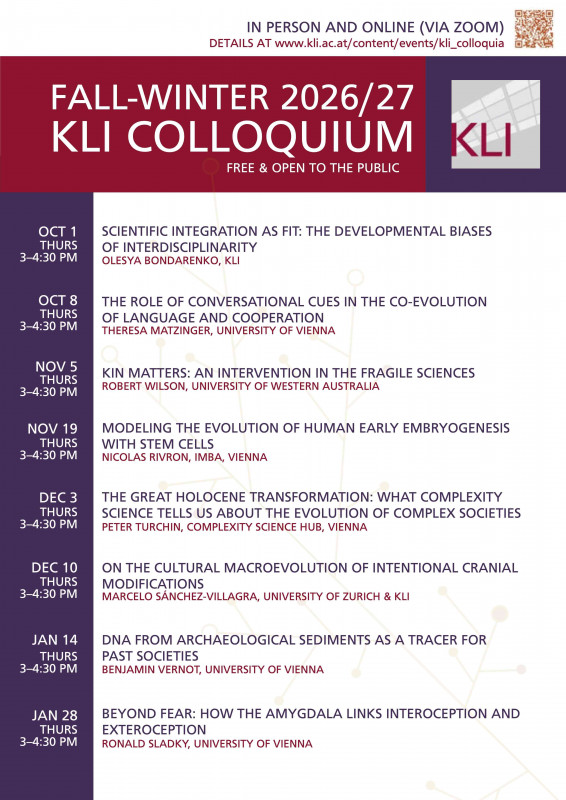
Scientific Integration as Fit: The Developmental Biases of Interdisciplinarity
Olesya BONDARENKO (KLI)
8 October 2026 (Thurs) 3-4:30 PM CET
The Role of Conversational Cues in the Co-Evolution of Language and Cooperation
Theresa MATZINGER (University of Vienna)
5 November 2026 (Thurs) 3-4:30 PM CET
Kin Matters: An Intervention in the Fragile Sciences
Robert A. WILSON (University of Western Australia)
19 November 2026 (Thurs) 3-4:30 PM CET
Modeling the Evolution of Human Early Embryogenesis with Stem Cells
Nicolas RIVRON (Institute of Molecular Biotechnology/IMBA, Vienna)
3 December 2026 (Thurs) 3-4:30 PM CET
Peter TURCHIN (Complexity Science Hub, Vienna)
10 December 2026 (Thurs) 3-4:30 PM CET
On the Cultural Macroevolution of Intentional Cranial Modifications
Marcelo SÁNCHEZ-VILLAGRA (University of Zurich)
14 January 2027 (Thurs) 3-4:30 PM CET
DNA from Archaeological Sediments as a Tracer for Past Societies
Benjamin VERNOT (University of Vienna)
28 January 2027 (Thurs) 3-4:30 PM CET
Beyond Fear: How the Amygdala Links Interoception and Exteroception
Ronald SLADKY (University of Vienna)
KLI Colloquia 2014 – 2026
Event Details

Topic description:
Marine fishes live in complex environments and show complex behaviors. I study their mating systems, and symbiotic behavior:
- I will give a guided tour through fish reproductive behavior, which includes nest building, monogamy, life birth, mouth brooding and male pseudo-parasitism. One strategy which is curiously missing is eusociality, and I will argue that this is due to the physical and biological boundary conditions found in the ocean. Specifically, long-range dispersal of larvae, sparsity of resource bursts, and the temporal frequency of physical disturbances in the oceans make the evolution of eusociality unlikely.
- A highly interesting symbiosis is the cooperation between gobies (small perciform fishes) and alpheid shrimp, where the shrimp constructs a burrow and the goby acts as a watchman. Using a database of fish anatomy, we show that the fish does NOT invest extra energy into its visual system as a consequence of the symbiosis. Lastly, I will present preliminary work on the possible neurobiological basis of the fish-shrimp communication system.
Biographical note:
Klaus M. Stiefel did his undergraduate work at the University of Vienna (microbiology) and his doctoral work at the University of Vienna and the Max Planck Institute for Brain Research (zoology/neuroscience). Research stints at the Salk Institute (La Jolla, USA), OIST (Japan) and the University of Western Sydney (Australia) followed. Currently Klaus is affiliated with the Neurolinx Research Institute (La Jolla, USA) and is based as an independent scientist in the Philippines, the epicenter of marine biodiversity. Klaus' research interest include fish biodiversity, reproduction & symbiosis (in marine biology) and neural oscillators (in neurobiology).
