

KLI Colloquia are invited research talks of about an hour followed by 30 min discussion. The talks are held in English, open to the public, and offered in hybrid format.
Join via Zoom:
https://us02web.zoom.us/j/5881861923?omn=85945744831
Meeting ID: 588 186 1923
Fall-Winter 2026/27 KLI Colloquium Series
1 October 2026 (Thurs) 3-4:30 PM CET 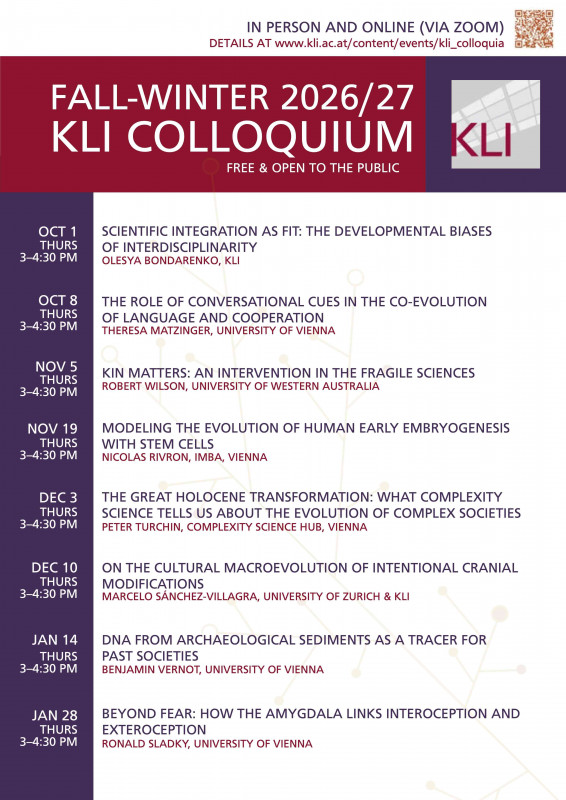
Scientific Integration as Fit: The Developmental Biases of Interdisciplinarity
Olesya BONDARENKO (KLI)
8 October 2026 (Thurs) 3-4:30 PM CET
The Role of Conversational Cues in the Co-Evolution of Language and Cooperation
Theresa MATZINGER (University of Vienna)
5 November 2026 (Thurs) 3-4:30 PM CET
Kin Matters: An Intervention in the Fragile Sciences
Robert A. WILSON (University of Western Australia)
19 November 2026 (Thurs) 3-4:30 PM CET
Modeling the Evolution of Human Early Embryogenesis with Stem Cells
Nicolas RIVRON (Institute of Molecular Biotechnology/IMBA, Vienna)
3 December 2026 (Thurs) 3-4:30 PM CET
Peter TURCHIN (Complexity Science Hub, Vienna)
10 December 2026 (Thurs) 3-4:30 PM CET
On the Cultural Macroevolution of Intentional Cranial Modifications
Marcelo SÁNCHEZ-VILLAGRA (University of Zurich)
14 January 2027 (Thurs) 3-4:30 PM CET
DNA from Archaeological Sediments as a Tracer for Past Societies
Benjamin VERNOT (University of Vienna)
28 January 2027 (Thurs) 3-4:30 PM CET
Beyond Fear: How the Amygdala Links Interoception and Exteroception
Ronald SLADKY (University of Vienna)
KLI Colloquia 2014 – 2026
Event Details
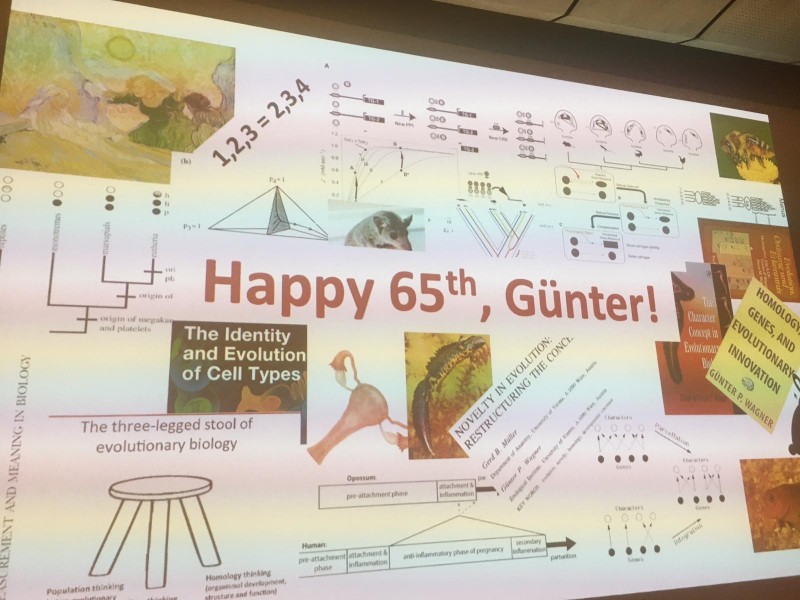
Günter P. Wagner is an evolutionary geneticist with training in biochemcial engineering, zoology and mathematics from the University of Vienna, Austria. He spent six postdoctoral years at the Max Planck Institutes for Biophysical Chemistry (Goettingen, Germany) and for Developmental Biology (Tübingen, Germany). His academic career started at the University of Vienna and in 1991 he received a call to assume a full professorship at the Biology Department at Yale. From 1996 to 2001 he was Chair of the Department of Ecology and Evolutionary Biology at Yale, and in 2010 his lab moved to the Systems Biology Institute at Yale's West Campus.
Dr. Wagner's research interest is the evolution of gene regulation as it pertains to the origin of evolutionary novelties. In particular the lab is focusing on the evolution of the endometrial stromal cells in the context of the evolutionary origin of pregnancy. Another focus of my lab is the developmental basis of character identity, as for instance in the case of digit identity of birds.
In 1992 Dr. Wagner received the MacArthur Fellowship for my research on the developmental basis of homology and in 1997 he was elected both to become corresponding member of the Austrian Academy of Sciences, and Fellow of the American Association for the Advancement of Science. In 2010 Dr, Wagner was elected to the American Academy of Arts and Sciences.
