

KLI Colloquia are invited research talks of about an hour followed by 30 min discussion. The talks are held in English, open to the public, and offered in hybrid format.
Join via Zoom:
https://us02web.zoom.us/j/5881861923?omn=85945744831
Meeting ID: 588 186 1923
Fall-Winter 2026/27 KLI Colloquium Series
1 October 2026 (Thurs) 3-4:30 PM CET 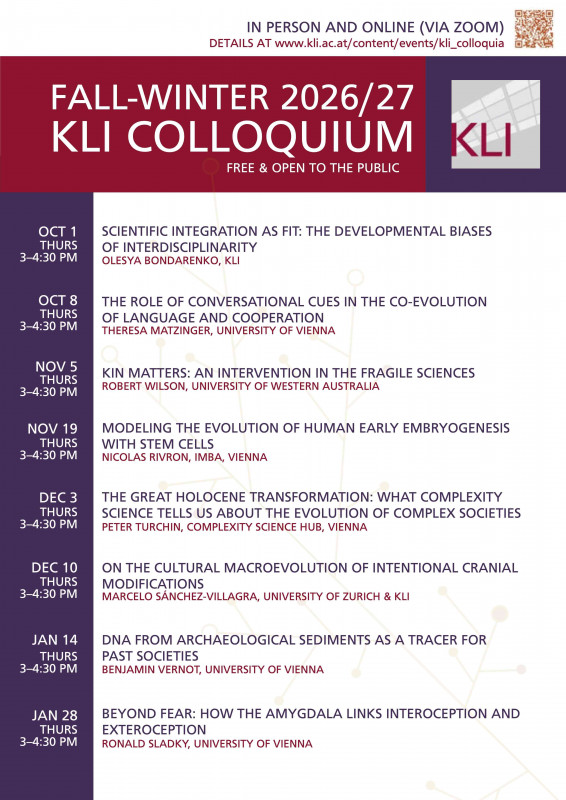
Scientific Integration as Fit: The Developmental Biases of Interdisciplinarity
Olesya BONDARENKO (KLI)
8 October 2026 (Thurs) 3-4:30 PM CET
The Role of Conversational Cues in the Co-Evolution of Language and Cooperation
Theresa MATZINGER (University of Vienna)
5 November 2026 (Thurs) 3-4:30 PM CET
Kin Matters: An Intervention in the Fragile Sciences
Robert A. WILSON (University of Western Australia)
19 November 2026 (Thurs) 3-4:30 PM CET
Modeling the Evolution of Human Early Embryogenesis with Stem Cells
Nicolas RIVRON (Institute of Molecular Biotechnology/IMBA, Vienna)
3 December 2026 (Thurs) 3-4:30 PM CET
Peter TURCHIN (Complexity Science Hub, Vienna)
10 December 2026 (Thurs) 3-4:30 PM CET
On the Cultural Macroevolution of Intentional Cranial Modifications
Marcelo SÁNCHEZ-VILLAGRA (University of Zurich)
14 January 2027 (Thurs) 3-4:30 PM CET
DNA from Archaeological Sediments as a Tracer for Past Societies
Benjamin VERNOT (University of Vienna)
28 January 2027 (Thurs) 3-4:30 PM CET
Beyond Fear: How the Amygdala Links Interoception and Exteroception
Ronald SLADKY (University of Vienna)
KLI Colloquia 2014 – 2026
Event Details

Topic description / abstract:
The Emerging Infectious Disease (EID) crisis has been a global health security challenge for decades, with COVID-19 serving as only the latest example of our inability to prevent outbreaks. In lack of implementing novel evolutionary knowledge explaining the process of emergence, our main focus remains preparing for the inevitable. The Stockholm paradigm (SP) is an alternative evolutionary framework that suggests host changes leading to EID can be predicted because preexisting genetic capacities for colonizing new hosts are highly specific and phylogenetically conservative. The DAMA (Document, Assess, Monitor, Act) protocol is a policy extension of the SP that can both prevent and mitigate EID by enhancing traditional efforts through adding early warning signs and predicting transmission dynamics.
In this talk, I show the importance of establishing efficient communication channels between various stakeholders affected by EIDs. I describe implementation strategies of preventive interventions on global, regional and local scales, and provide guidelines for using such strategies in relevant policy environments of human, livestock and crop diseases.
Biographical note:
Orsolya Rita Bajer-Molnár Ph.D. is an evolutionary biologist, with a passion for both research and education. She received her Master’s diploma from Eötvös Loránd University in Evolutionary biology, Ecology and Systematics. Five years later she completed her Ph.D in Behavioural ecology and Evolutionary biology. She then won a postdoctoral scholarship at Dartmouth College, NH, after which she continued research at UFRN in Brazil. Upon returning, she turned towards the evolutionary dynamics of emerging infectious diseases, which she is currently working on in collaboration with the University of Nebraska (USA) and Centre for Ecology Research (Hungary). She has been a senior fellow at the Konrad Lorenz Institute for Evolution and Cognition Research before working at the Medical University of Vienna.
Throughout her research, she had always been interested in science communication. Overseas she organized networking events, conferences and outreach programmes, and taught graduate and undergraduate students. She took an active role in science communication, and after numerous appearances she just recently gave a TedX talk. Her aim is to increase the visibility of research, and thus facilitate a combined effort to prevent the emerging infectious diseases.
