

KLI Colloquia are invited research talks of about an hour followed by 30 min discussion. The talks are held in English, open to the public, and offered in hybrid format.
Join via Zoom:
https://us02web.zoom.us/j/5881861923?omn=85945744831
Meeting ID: 588 186 1923
Fall-Winter 2026/27 KLI Colloquium Series
1 October 2026 (Thurs) 3-4:30 PM CET 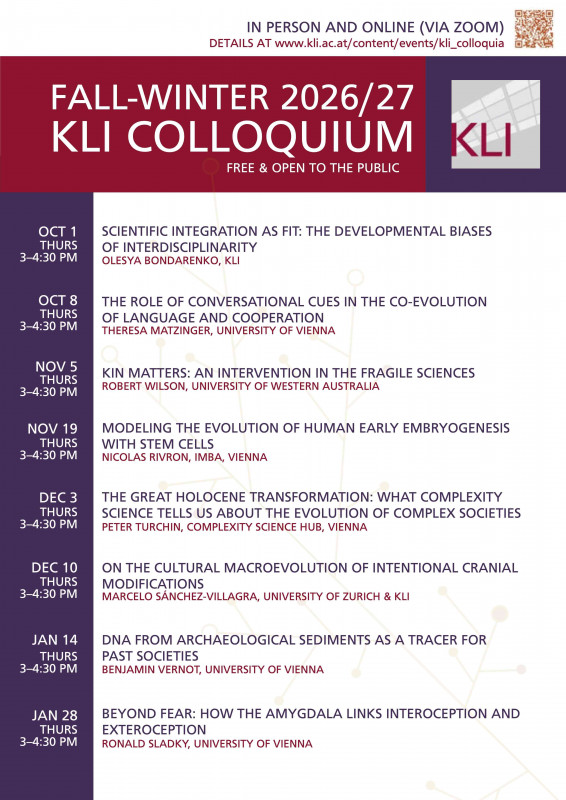
Scientific Integration as Fit: The Developmental Biases of Interdisciplinarity
Olesya BONDARENKO (KLI)
8 October 2026 (Thurs) 3-4:30 PM CET
The Role of Conversational Cues in the Co-Evolution of Language and Cooperation
Theresa MATZINGER (University of Vienna)
5 November 2026 (Thurs) 3-4:30 PM CET
Kin Matters: An Intervention in the Fragile Sciences
Robert A. WILSON (University of Western Australia)
19 November 2026 (Thurs) 3-4:30 PM CET
Modeling the Evolution of Human Early Embryogenesis with Stem Cells
Nicolas RIVRON (Institute of Molecular Biotechnology/IMBA, Vienna)
3 December 2026 (Thurs) 3-4:30 PM CET
Peter TURCHIN (Complexity Science Hub, Vienna)
10 December 2026 (Thurs) 3-4:30 PM CET
On the Cultural Macroevolution of Intentional Cranial Modifications
Marcelo SÁNCHEZ-VILLAGRA (University of Zurich)
14 January 2027 (Thurs) 3-4:30 PM CET
DNA from Archaeological Sediments as a Tracer for Past Societies
Benjamin VERNOT (University of Vienna)
28 January 2027 (Thurs) 3-4:30 PM CET
Beyond Fear: How the Amygdala Links Interoception and Exteroception
Ronald SLADKY (University of Vienna)
KLI Colloquia 2014 – 2026
Event Details
Topic description / abstract:
While there is general consensus about a knowledge-action gap in ecology and conservation, its causes are hotly-debated. One perspective is that knowledge flows unidirectionally, from scientist to practitioner, and the gap is mainly a consequence of inadequacies in the generation, communication and use of scientific knowledge. The other perspective is that knowledge flows bi-directionally between scientist and practitioner, and the gap reflects a lack of interactions between scientist and practitioner. Independent of this debate, knowledge, whether produced by scientists or jointly by scientists and practitioners, is believed to inform practice in different ways, including instrumentally, conceptually and symbolically. In this project, I provide empirical grist to these theoretical mills based on oral histories of Indian conservation biologists about their experiences in building knowledge for conservation action and policy.
India presents a unique case in the global debate on the science-conservation gap. While Conservation Biology in India is largely based upon ideas and theories from the west (what one might call Michael Soulé’s Conservation Biology), India’s historical resistance to foreign scientists working within its borders has meant that its conservation biology community consists entirely of Indians, in contrast to other countries of the global south, where Conservation Biology is dominated by scientists from the global north. Indian conservation scientists, while engaging with western Conservation Biology, have had their ears closer to the ground, questioned Conservation Biology’s relevance and adopted a much more bottom-up approach in their work. The Indian conservation science community is, therefore, likely to contain a wealth of unique experiences and perspectives about science’s role in conservation.
Biographical note:
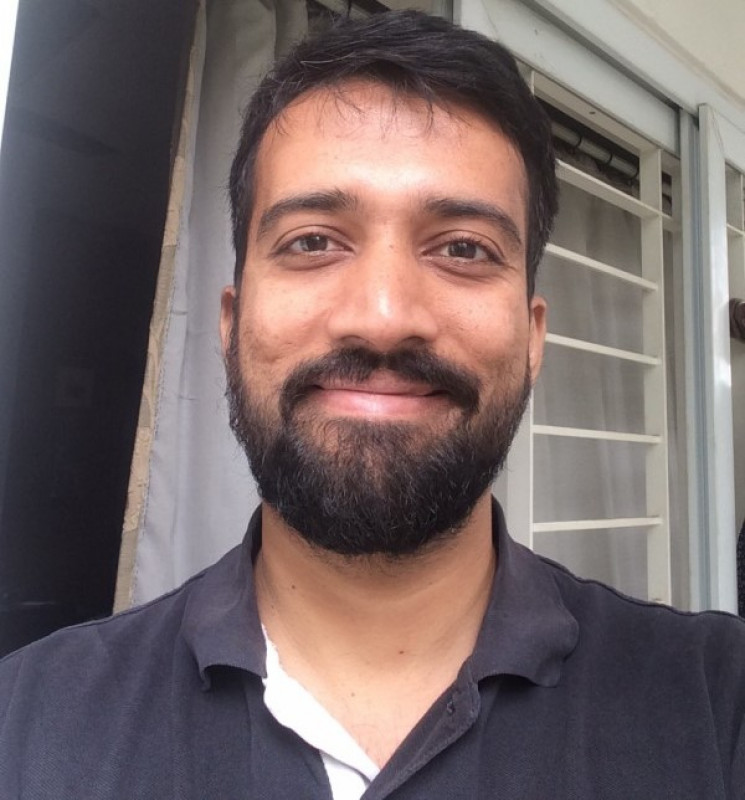
Hari Sridhar is a senior fellow at KLI and oversees the oral history programme of the Archives at NCBS (National Centre for Biological Sciences). Hari is currently involved in two Oral History projects examining the contemporary history of conservation in India, especially in relation to the intersection of ecological knowledge and conservation practice. Over the last eight years, Hari has also led another interview project with authors of classic papers in Ecology and Evolution (https://reflectionsonpaperspast.com/). Hari’s other major research interest lies in understanding the causes and consequences of heterospecific sociality, a topic he researched during his PhD and post-doctoral years at the Indian Institute of Science, Bangalore, and which he continues to stay in touch with through collaborative projects. In addition to doing research, Hari is a visiting lecturer at Azim Premji University and National Centre for Biological Sciences in Bengaluru, and has been an editor of the magazine Current Conservation.
