

KLI Colloquia are invited research talks of about an hour followed by 30 min discussion. The talks are held in English, open to the public, and offered in hybrid format.
Join via Zoom:
https://us02web.zoom.us/j/5881861923?omn=85945744831
Meeting ID: 588 186 1923
Fall-Winter 2026/27 KLI Colloquium Series
1 October 2026 (Thurs) 3-4:30 PM CET 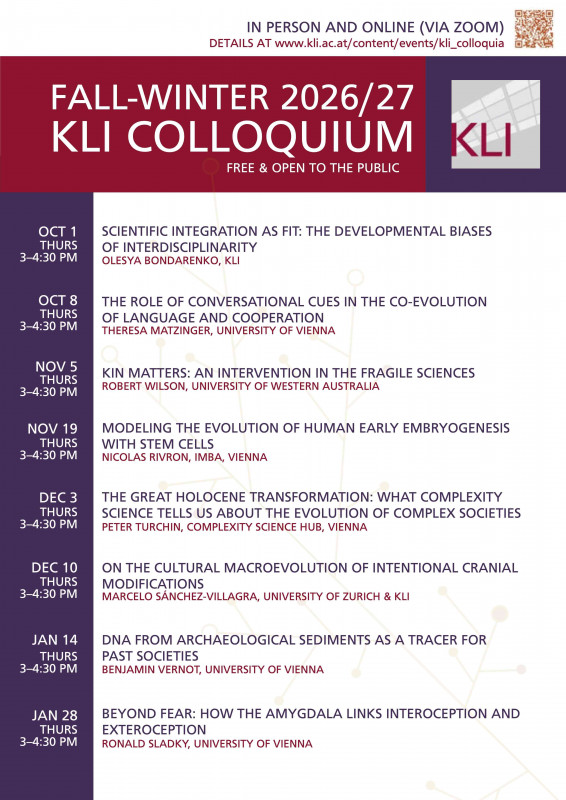
Scientific Integration as Fit: The Developmental Biases of Interdisciplinarity
Olesya BONDARENKO (KLI)
8 October 2026 (Thurs) 3-4:30 PM CET
The Role of Conversational Cues in the Co-Evolution of Language and Cooperation
Theresa MATZINGER (University of Vienna)
5 November 2026 (Thurs) 3-4:30 PM CET
Kin Matters: An Intervention in the Fragile Sciences
Robert A. WILSON (University of Western Australia)
19 November 2026 (Thurs) 3-4:30 PM CET
Modeling the Evolution of Human Early Embryogenesis with Stem Cells
Nicolas RIVRON (Institute of Molecular Biotechnology/IMBA, Vienna)
3 December 2026 (Thurs) 3-4:30 PM CET
Peter TURCHIN (Complexity Science Hub, Vienna)
10 December 2026 (Thurs) 3-4:30 PM CET
On the Cultural Macroevolution of Intentional Cranial Modifications
Marcelo SÁNCHEZ-VILLAGRA (University of Zurich)
14 January 2027 (Thurs) 3-4:30 PM CET
DNA from Archaeological Sediments as a Tracer for Past Societies
Benjamin VERNOT (University of Vienna)
28 January 2027 (Thurs) 3-4:30 PM CET
Beyond Fear: How the Amygdala Links Interoception and Exteroception
Ronald SLADKY (University of Vienna)
KLI Colloquia 2014 – 2026
Event Details

Join Zoom Meeting
https://us02web.zoom.us/j/5881861923?omn=85945744831
Meeting ID: 588 186 1923
Topic description / abstract:
Around 3.5 million years ago (Ma), hominins began to manufacture simple stone tools, which marked the beginning of the Stone Age, that lasted until about 5,000 years ago. Most textbooks on human evolution focus heavily on the Stone Age and cognitive archeologists frequently assess the quality of stone tools at different points in time to speculate about the evolution of the brain and intelligence in human predecessors. Some scholars even analyze stone tools to theorize about which hominins experienced evolutionary “cognitive leaps,” and when. However, hominin ancestors diverged from the lineage that led to modern chimpanzees around 6.5 Ma, long before the Stone Age began. The time between 6.5 and 3.5 Ma, identified here as the Botanic Age, has received relatively little attention in studies of hominin cognitive evolution. Various lines of evidence suggest that the emergence and refinement of bipedalism during the Botanic Age sparked changes in the brain that (much) later contributed to the emergence of humanlike musical and linguistic abilities. It is also likely that hominins were inventing new kinds of tools made from vegetal matter, such as baby slings, long before they began modifying rocks into useful shapes. If so, prolonged evolution of bipedalism and a proliferation of botanical inventions were more important than previously believed for sculpting advanced cognition in our prehistoric ancestors. In sum, early hominins’ “formative years” began during the first three and a half million years of their existence rather than during the Stone Age
Biographical note:
Dean Falk is the Hale G. Smith Professor of Anthropology and a Distinguished Research Professor at Florida State University in Tallahassee, where she teaches and does research. Having trained as a biological anthropologist, Falk is interested in the evolution of the brain and the emergence of human cognitive abilities that led to language, music, analytical thinking, and warfare. She has directed collaborative research on the brains (or traces of them imprinted in fossilized skulls) of nonhuman primates, prehistoric human relatives, and recent humans including Homo floresiensis (aka “Hobbit”) and Albert Einstein. In addition to numerous scientific and popular articles, Falk has written books including Braindance: Revised and Expanded Edition (2004), Finding Our Tongues: Mothers, Infants, and the Origins of Language (2009), The Fossil Chronicles: How Two Controversial Discoveries Changed Our View of Human Evolution (2011), Geeks, Genes, and the Evolution of Asperger Syndrome (2018, coauthored with Eve Penelope Schofield), and The Botanic Age: Planting the Seeds of Human Evolution (2025). She is currently working on a collaborative volume that provides English translations of previously unpublished letters written to the Austrian pediatrician Hans Asperger before, during, and after WWII. More information may be found at: www.deanfalk.com
